Tree Fox · Adelaide arborists
Eucalyptus Pruning Adelaide — Sugar Gum, Red Gum, Lemon-Scented
By Tree Fox · Published 5 May 2026
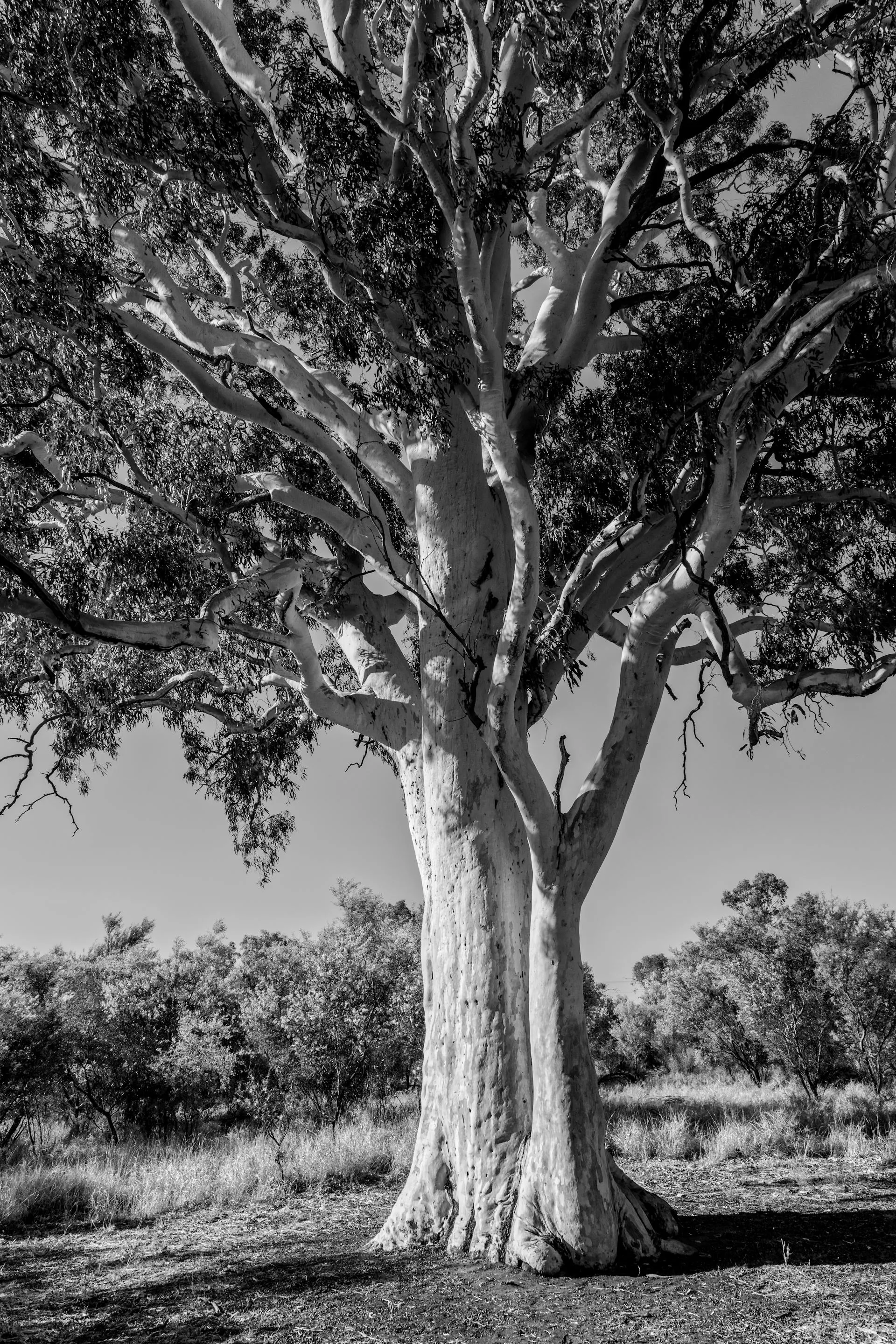
Sugar Gums, River Red Gums and Lemon-Scented Gums in Adelaide — A Homeowner’s Care Guide
Last updated: 5 May 2026.
If you’ve got a gum tree in Adelaide, the odds are good it’s one of three: a sugar gum (Eucalyptus cladocalyx), a river red gum (E. camaldulensis) or a lemon-scented gum (Corymbia citriodora). Eucalyptus pruning in Adelaide works best in the cooler months — May to August — and is governed by South Australia’s regulated-tree rules the moment the trunk passes 1 metre in circumference at 1 metre off the ground. Heavy reduction on a regulated gum is a development application, not a Saturday job. Light maintenance pruning is exempt up to 30% of the crown every five years. Everything else — summer branch drop, the dwelling-distance carve-out, the species that don’t get the carve-out — is below.
This is the species page the permits guide and the danger-signs guide both lean on. If you’re trying to decide whether to prune, remove or just leave a gum alone, start with identification.
Identifying the three gums you’ll most likely have
The three species cover most of the metro’s mature canopy. They look different enough that you can usually call it from the footpath.
Sugar gum (Eucalyptus cladocalyx)
- Bark: smooth, mottled cream-yellow-grey, sheds in irregular patches. Trunk often appears almost luminous in low sun.
- Leaves: dark glossy green on top, distinctly paler underneath. Adult leaves are lance-shaped, 8–17 cm long.
- Form: tall, straight-trunked, often with a relatively narrow crown for the trunk diameter.
- Where you see them: windbreak rows on Hills properties, paddock edges, parks across the metro. Native to South Australia (southern Flinders, Eyre Peninsula, Kangaroo Island originally).
- Watch for: in-trunk decline of older specimens — sugar gums are prone to internal cavities that don’t show on the outside.
River red gum (Eucalyptus camaldulensis)
- Bark: smooth, mottled white-grey-pink, peels in long ribbons. Lower trunk often retains rough bark; upper limbs are pale and clean.
- Leaves: narrow, lance-shaped, dull grey-green on both sides.
- Form: broad spreading crown, heavy lateral limbs that run almost horizontal off the trunk. The classic Adelaide eucalypt silhouette.
- Where you see them: along the Torrens, Sturt River, Brown Hill Creek, Onkaparinga; in older premium-east gardens (Burnside, St Peters, Walkerville) where the original creek-line trees were kept; on Hills paddocks. Designing a garden around a mature river red gum is its own discipline — the landscaping designers we cross-refer in Adelaide tend to plan paving and irrigation outside the structural root zone, which keeps the tree healthy and the hardscape from heaving.
- Watch for: summer branch drop (see below) — river red gums are the species most often cited for it.
Lemon-scented gum (Corymbia citriodora)
- Bark: smooth, powdery, pale grey-pink, sheds annually leaving the trunk almost white. Distinctively clean-looking trunk.
- Leaves: lance-shaped, glossy green; crushed leaves smell strongly of lemon, which is the easiest field test.
- Form: tall, slender, with a relatively open crown; often planted in rows as street trees.
- Where you see them: along Greenhill Road, in NPSP and Burnside streetscapes, and as feature trees in larger eastern-suburb gardens.
- Watch for: stress cracks at major branch unions — lemon-scented gums have a documented tendency to develop included bark and split.
A quick trunk circumference at chest height tells you the rest. Anything past 1 m around (~32 cm diameter) is a regulated tree under SA law. Anything past 2 m around (~64 cm diameter) is a significant tree. The rules below apply.
Pruning eucalypts in Adelaide
Cool-season work, light cuts, never lopped. That’s the whole framework.
The window: May to August is the safe band. The cuts heal before the heat. Avoid pruning on hot days (over 30°C), on total fire ban days, and during active stress periods (drought, wind events). See the seasonal pruning calendar for the full year.
The technique: AS 4373 reduction. That’s the Australian Standard for amenity-tree pruning — small cuts back to lateral branches that can take over the leader role, no stub cuts, no flush cuts. A reduction prune leaves the tree looking smaller but structurally complete. A “lop” leaves it looking like a hat-stand.
The amount: 30% of the crown is the regulated-tree maintenance ceiling, no more than once every five years. For a non-regulated gum, the same 30% rule is sound horticulture even where it isn’t law — eucalypts respond to heavy crown removal with epicormic shoots that are weakly attached and dangerous in their own right.
Why “lopping” backfires on eucalypts: topping a gum doesn’t make it smaller for long. It triggers a flush of fast vertical regrowth from dormant buds, often poorly attached at the cut union. Within five years the tree is back to its previous height with weaker branch structure. The same pattern shows up in trees that have been heavily pruned by under-skilled crews — see arborist vs tree lopper for the credentials distinction.
What’s worth doing every few years:
- Deadwood removal (any time — dead is dead)
- End-weight reduction on heavy lateral limbs that overhang structures
- Crown lifting to clear the lawn, the driveway, the lower roof
- Selective thinning of crossed and rubbing branches
What’s not worth doing:
- “Topping” to a uniform height
- Removing major scaffold limbs to open a view
- Crown reduction beyond 30%
- Pruning a regulated tree without checking the rules first
Summer branch drop — the eucalypt phenomenon
Summer branch drop is real, it’s documented, and it’s almost unique to eucalypts and a few oaks. The pattern: a mature, apparently healthy tree drops a major lateral limb on a hot, calm afternoon, often with no warning and no obvious defect on the failed branch.
The mechanism is debated but the leading explanation runs along these lines. On still, humid afternoons, transpiration drops sharply — the tree stops moving water out through its leaves at the rate it normally would. Internal pressure builds in the wood. Combine that with the natural weight of a long horizontal limb, possible micro-fissures from previous heat-cycles, and a cell-wall weakening from elevated ethylene production, and you get failures at the union. The branches that fail are typically horizontal, often a metre off the trunk, often on hot calm afternoons in the late summer.
Which species are most prone: river red gums most often, then sugar gums, then lemon-scented gums. The phenomenon shows up in eucalypts globally — California, South Africa, southern Europe — not just Australia.
How to manage the risk:
- End-weight reduction on long horizontal limbs that overhang houses, sheds, cars, paths or play areas. Less leverage = lower failure risk.
- Annual visual inspection by an arborist for cracks, cavities, included bark and unions that look strained
- Avoid heavy pruning that triggers a regrowth flush of poorly attached new wood
- Don’t park under a mature gum on hot calm summer afternoons
For a fuller framework on tree-failure indicators, see how to tell if a tree is dangerous.
When a gum is regulated under SA law
The state framework, in plain English:
| Trunk circumference (at 1 m above ground) | Status |
|---|---|
| Under 1 m (under ~32 cm diameter) | Not regulated |
| 1–2 m (32–64 cm diameter) | Regulated tree |
| Over 2 m (over ~64 cm diameter) | Significant tree |
For most species, a tree within 3 metres of an existing dwelling or pool is exempt. Eucalypts don’t get this exemption. Any tree in the genus Eucalyptus, Corymbia or Angophora is regulated regardless of distance to your house. Willow myrtle (Agonis flexuosa) is the other genus excluded from the dwelling carve-out.
That single rule catches more Adelaide owners than any other. The plumber said the gum was too close to be a problem. The agent said you could remove it after settlement. The neighbour said theirs was fine. None of it overrides the species exclusion. If it’s a gum and the trunk is over 1 m around, you need a development application to remove it.
The April 2024 reform package tightened exemptions and increased fines. Maximum penalty for unauthorised removal of a significant tree is now in five-figure territory. The Burnside conviction of February 2025 — a $10,000 fine for the unauthorised removal of a regulated tree at Rosslyn Park — is the precedent every owner should know about. Full breakdown in the permits guide.
What’s exempt without an application (regulated trees, not significant):
- Genuine deadwood removal
- Maintenance pruning up to 30% of the crown, once every five years
- Removal where the tree presents an immediate threat to life or property (the test is high — get an arborist report)
- Removal where there’s no other option for a development that already has approval (the threshold is also high)
What needs an application:
- Removal of a regulated or significant gum
- Heavy reduction beyond 30% of the crown
- Most root work on a regulated tree
For the cost side of larger removals, see large gum tree removal cost in Adelaide.
Common gum tree problems we see in Adelaide
The recurring issues, in roughly the order they cause work:
Saturated-clay root plate failure (foothills). Belair, Blackwood, Eden Hills, Stonyfell, parts of Burnside on the slope. The clay holds water. After a wet winter, a mature gum on a sloped clay block can lose root anchorage and lean — sometimes overnight. The signs are a fresh soil heave on the upslope side and new exposed roots on the downslope. This is an emergency: get an arborist on site the day you notice it.
Deadwood over targets. Eucalypts shed dead branches readily. A few small twigs are normal. Deadwood the diameter of your forearm hanging over a parking pad, a play area or a bedroom roof is removal work, not maintenance.
Cracks in lemon-scented gum unions. Included bark — where the union between two co-dominant stems traps bark inside instead of forming proper wood — is the classic failure point. Look for vertical cracks at the Y-shape where two main stems leave the trunk. If you see one, you’re not pruning that tree without an arborist’s reduction plan.
Sugar gum decline. Older sugar gums (especially in windbreak rows planted in the 1950s–70s) develop internal cavities and major-limb dieback. They look fine until they don’t. The pattern is gradual upper-canopy thinning over two or three seasons. By the time half the crown is dead, the tree is past saving.
Insect pressure. Lerps and psyllids on lemon-scented gums and SA blue gums in some seasons. Eucalypt psyllids cause a sticky honeydew rain under affected trees and can defoliate young growth. Most populations crash naturally; chemical intervention rarely makes sense on mature trees.
Root invasion of services. River red gums in particular have aggressive surface roots that find drains, footings and pavement joints. The damage shows up as lifted hardscape, recurrent drain blockages and (occasionally) settlement cracks in lightweight wall footings. Removing the tree usually isn’t the answer — root barriers, drain repairs and selective surface-root pruning are cheaper and don’t require council approval if done properly.
When to call an arborist for your gum
A reasonable rule:
- Annual visual by a qualified arborist on any mature gum within striking distance of a structure, on a sloped block, or showing any of the warning signs above
- Reduction prune every five to seven years on long horizontal limbs over targets
- Deadwood removal as needed (any time)
- Pre-storm inspection in late autumn — before Adelaide’s June–September storm window
- Remove when the tree is structurally compromised beyond reduction’s reach, dead, or unsalvageably declined
For routine work see our tree pruning service. For removal — including the council application — see tree removal and the Adelaide Hills location page where most large-gum work happens.
FAQs about gum trees in Adelaide
Can I remove a gum tree near my house in Adelaide? Only if the trunk circumference is under 1 metre at 1 metre off the ground (so the tree isn’t regulated), or if you have development approval. The standard “within 3 metres of a dwelling” exemption that applies to most regulated trees does not apply to eucalypts, corymbias, angophoras or willow myrtle. A regulated gum needs a development application even if it’s right against the wall of the house.
Are gum trees dangerous? A healthy mature gum is no more dangerous than any other large tree, but eucalypts have one species-specific risk pattern called summer branch drop — major lateral limbs occasionally fail on hot, calm afternoons even on apparently healthy trees. The risk is manageable with end-weight reduction pruning and annual inspection. Sloped clay blocks in the foothills carry the additional risk of root-plate failure after wet winters.
When should I prune a river red gum? May to August is the safe window in Adelaide — cool enough that the cuts heal before the heat, dry enough to avoid disease pressure, and outside the active growing season. Light reduction work only — no more than 30% of the crown. Heavy pruning of a river red gum triggers epicormic regrowth that’s weakly attached and worse than what was removed.
What’s summer branch drop? A documented phenomenon where mature eucalypts (and some oaks) shed major lateral limbs on hot, still afternoons with no obvious external defect. The leading explanation involves reduced transpiration on humid still days, internal pressure changes, and ethylene-related cell-wall weakening at the union. Risk is highest on long horizontal limbs of mature river red gums and is reduced by end-weight pruning.
How do I tell a sugar gum from a river red gum? Bark is the easiest field test. Sugar gums have smooth mottled cream-yellow-grey bark and a relatively narrow crown. River red gums have smooth white-grey-pink ribbon bark on the upper trunk with rough dark bark on the lower trunk, and a broad spreading crown with heavy horizontal limbs. Leaves of a sugar gum are dark glossy green with a paler underside; river red gum leaves are dull grey-green on both sides.
Sources
- PlanSA — Significant and regulated trees
- PlanSA — Minister’s Notice, list of exempt species (May 2024)
- Arboriculture & Urban Forestry — Summer Branch Drop (peer-reviewed)
- Law Handbook SA — Significant and Regulated Trees
This article is general guidance on gum trees in South Australian conditions. For a regulated tree, get a qualified arborist on site and the council application moving before any heavy work starts.