Tree Fox · Adelaide arborists
Arborist vs Tree Lopper — What's the Difference?
By Tree Fox · Published 5 May 2026
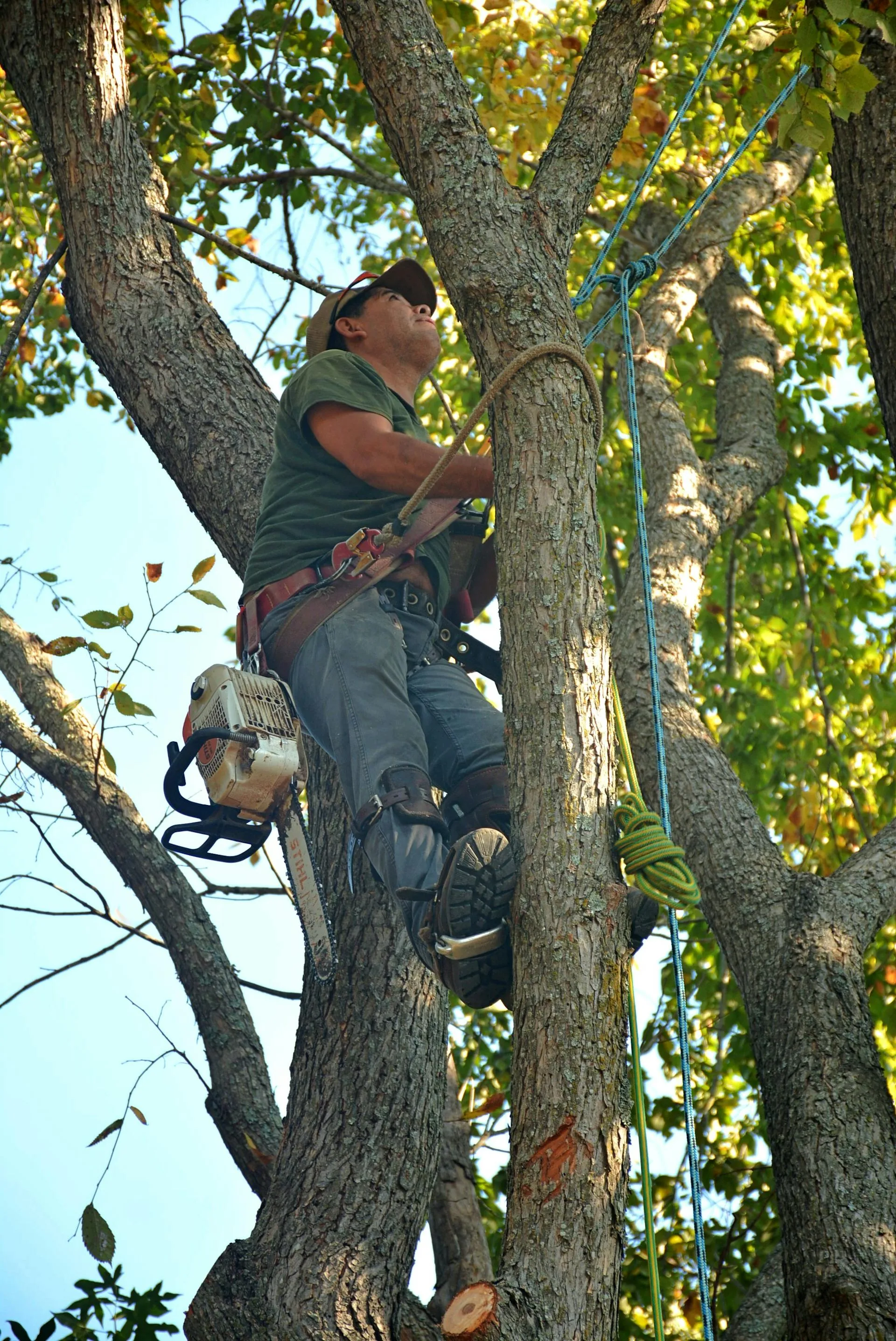
Arborist vs Tree Lopper: What’s the Real Difference (and Which Do You Need)?
Last updated: 5 May 2026.
An arborist is a tree-care professional with formal qualifications (typically AQF Level 3 or Level 5), trained in tree biology, structural assessment, climbing, and species-specific care. A tree lopper is a more general term — sometimes used by qualified arborists colloquially, sometimes used by unqualified contractors who’ll cut a tree for a price. The practical difference is training, judgement, and what they can legally do: an arborist diagnoses, plans, and prunes to standards; a tree lopper, in the literal sense, cuts back. For most regulated-tree work in Adelaide, you need a qualified arborist — both because the job needs the judgement and because council and insurer expectations have moved on.
This article walks through the qualifications, what each actually does, when each is right for the job, and how to verify credentials in Adelaide.
The short version
| Arborist | Tree Lopper | |
|---|---|---|
| Qualification | AQF Level 3 (Cert III in Arboriculture) minimum; Level 5 (Diploma) for consulting | Often none formally required |
| Trained in | Tree biology, biomechanics, climbing, rigging, pruning standards, diagnosis | Cutting and removal; varies widely |
| Can write reports | Yes (Level 5 for council-grade) | No |
| Council application work | Yes — arborist reports for development approval | No |
| Pruning to AS 4373 | Yes, trained to the standard | Often not |
| Climbing certification | Cert III qualified climbers | Varies; often not certified |
| Public liability insurance | $10M–$20M expected | Varies; sometimes minimal or none |
| Best for | Regulated trees, council applications, structural pruning, complex removals, diagnosis | Simple, low-risk removals on clearly exempt trees — but you should verify credentials anyway |
What an arborist actually is
In Australia, “arborist” is a recognised vocational profession with a defined training pathway. The standard qualifications:
AQF Level 3 — Certificate III in Arboriculture (AHC30820)
The working-arborist qualification. Trains in:
- Tree biology and species identification
- Climbing and aerial rescue
- Pruning to Australian Standard AS 4373 (Pruning of Amenity Trees)
- Tree felling, sectional dismantling, rigging
- Use of chainsaws, EWPs (cherry-pickers), chippers
- Workplace safety, traffic management, first aid
A Cert III arborist is the person up the rope or in the bucket. This is the qualification we want to see in any arborist physically performing the work on your property.
AQF Level 5 — Diploma of Arboriculture (AHC50520)
The consulting-arborist qualification. Builds on Cert III with:
- Tree risk assessment to industry standard
- Tree health diagnosis (pathogens, structural defects, decay)
- Arborist report writing for council applications
- Significant tree assessment and tree management plans
- Site-specific advice for development, construction, and pre-purchase
A Level 5 arborist writes the arborist reports that council applications need. If you’re applying to remove a regulated or significant tree under the PDIA, the arborist authoring the supporting report should be Level 5. Many councils explicitly require it.
Industry membership
Beyond the formal AQF qualifications, the credible industry bodies in Australia are:
- Arboriculture Australia (AA) — peak national body, members directory at trees.org.au
- Tree Contractors Association Australia (TCAA) — industry association for tree-care contractors
- Institute of Australian Consulting Arboriculturists (IACA) — the consulting-arborist body for Level 5 work
Membership isn’t legally required — but it’s a proxy for someone who treats arboriculture as a profession rather than a side hustle.
What a tree lopper is (and isn’t)
“Tree lopper” is a colloquial Australian term that doesn’t have a formal qualification behind it. In practice, the term gets used three ways:
- By qualified arborists as informal shorthand for the work itself (“tree lopping” = pruning and removal). The brand on the side of the truck might say “tree lopping” but the people swinging the chainsaw are Cert III arborists.
- By skilled but informally-trained operators — long experience, no formal certificate, often family businesses going back decades. Some are excellent; some are problems waiting to happen.
- By unqualified contractors — a chainsaw, a ute, a Facebook ad. No insurance, no understanding of regulated trees, no climbing certification. This is the segment that produces most of the property damage and council prosecutions in SA.
The word itself doesn’t tell you which category the operator falls into. Credentials and insurance do.
”Lopping” the activity vs “tree lopper” the person
Useful to separate. Lopping as an activity is a specific kind of tree work: cutting back limbs to stubs, often with the goal of size reduction. Modern arboricultural standards (AS 4373) discourage lopping in most circumstances because it:
- Removes too much foliage at once and stresses the tree
- Creates wounds that don’t heal cleanly
- Stimulates weakly-attached regrowth from the cut sites
- Sets the tree up for failure 5–10 years later
A qualified arborist usually does reduction pruning — selective cuts back to lateral branches that take over the role of the leader — rather than topping or lopping. The result looks more natural, heals better, and lasts.
Where the term “lopping” makes sense is in fruit trees, hedges, and some heritage management contexts. For amenity trees in Adelaide gardens, what you usually want is structural pruning by an arborist, not lopping. If the broader garden is being reworked at the same time, talk to a landscaping designer for Adelaide outdoor projects before the structural pruning starts — the pruning brief sometimes shifts when a paving or pergola plan goes in alongside it.
We do offer a tree lopping service — the term is what most customers search for — but the work itself is performed to AS 4373 standards by qualified arborists.
When you need an arborist (not a generic lopper)
Five situations where the qualification matters more than usual:
1. The tree is regulated or significant
Any tree with a trunk circumference of 1 m or more (measured 1 m above the ground) is regulated under the SA Planning, Development and Infrastructure Act 2016. Most “tree-damaging activity” on a regulated tree needs council approval. The application generally requires an arborist report by an AQF Level 5 arborist. An unqualified lopper can’t legally provide one. See tree removal permits in Adelaide.
2. You need diagnosis, not just removal
If the question is “should this tree come down?” — not “the answer is yes, please remove it” — you need an arborist. Diagnosis covers:
- Decay assessment (resistograph, sounding)
- Structural risk evaluation
- Disease and pest identification
- Whether reduction pruning or cabling could save the tree
- Whether the tree poses an actual risk to people or property
A removalist who just quotes the cut isn’t diagnosing. They’re costing.
3. The tree is large, structurally complex, or near targets
Big eucalypts over tile roofs, mature plane trees over powerlines, sectional dismantles where every cut has to land in a 2 m drop zone — this is climbing-and-rigging work that needs Cert III qualifications and the right gear. The bargain price from someone unqualified is the bargain that goes wrong on the day.
4. Insurance and council exposure matters
Two practical points:
- A contractor with inadequate public liability insurance who damages your property leaves you holding the cost. $20M public liability and current WorkCover are reasonable expectations for any tree work.
- A contractor who damages a regulated tree without approval doesn’t leave the council penalty with themselves. The penalty falls on the property owner. Up to $120,000 under the PDIA. The question of whether the contractor told you it was fine is irrelevant in court.
5. Reduction pruning, structural cabling, or formative pruning on young trees
Anything where the tree’s long-term health and structure are the goal — not just an immediate cut — is arborist territory. This is where the AS 4373 training pays off.
For more on what to look for in the tree itself, see how to tell if a tree is dangerous.
When a “tree lopper” is fine
Honest answer: there are jobs where a basic chainsaw operator is enough.
- A small ornamental clearly under the regulated threshold, in an open backyard, with a clear drop zone and nothing valuable underneath.
- A clearly dead listed-exempt species (Box Elder, Silver Maple, Weeping Willow on the listed exempt species list) — the council exemption applies and the tree’s structural condition is obvious.
- Routine hedge work by a gardening contractor, on a hedge that’s been managed for years and isn’t structurally complex.
Even on these jobs, you should still ask for the contractor’s public liability Certificate of Currency. The $400 you save on the cheap quote can vanish in a single insurance gap.
How to verify an arborist’s credentials in Adelaide
A short checklist for any contractor before they come on your property:
- Ask for the Cert III certificate or the Level 5 diploma. Real arborists are happy to send a PDF.
- Ask for current public liability Certificate of Currency. $20M is the standard for tree work in SA. Anything below $10M is light.
- Ask for current WorkCover. Required for anyone employing climbers and ground crew.
- Check the industry directories. Arboriculture Australia, TCAA, IACA member directories list verified members.
- Look at recent work. Photos of similar jobs, before/after, the names of streets they’ve worked on. A real Adelaide operator will know their patch.
- Search the council for prosecutions. The City of Burnside, in particular, publishes its convictions. If a contractor’s name appears, walk away.
For the regulatory background on convictions — including the recent Burnside $10,000 fine — see tree removal permits in Adelaide.
Pricing — does qualified cost more?
Not as much as people think. The price difference between a qualified arborist crew and an unqualified operator on the same job is rarely more than 10–20% — often less, because the qualified crew works faster, cleaner, and doesn’t damage the property.
Where the difference shows up is on the edge cases: complex jobs where the unqualified operator either underquotes (and adds extras on the day) or causes damage that the property owner ends up paying for. The arborist quote is the predictable number; the cheap quote is the variable one.
For typical Adelaide pricing on tree work, see tree removal cost in Adelaide.
Common credential red flags
Patterns that should make you pause:
- No website or only a Facebook page with no photos of recent work.
- A quote on the spot, sight-unseen. Real arborist quotes are written, after a site inspection, and itemised.
- A handwritten quote on a torn page. Paperwork standards correlate strongly with on-site standards.
- “I don’t need insurance for this kind of work.” Anyone working in trees needs current public liability.
- “Council won’t notice.” They might, they might not — but the question is whether the contractor takes the regulations seriously, and that answer tells you everything.
- Cash-only with no GST invoice. A contractor running cash-in-hand is usually running uninsured.
- Disposable trades. A van with no signage, no business name on quotes, and a phone number that’s a personal mobile.
Adelaide-specific context
The quality bar in Adelaide tree work has lifted noticeably over the last five years, driven by:
- The 2024 PDIA reforms tightening the regulated tree thresholds and shrinking the dwelling exemption from 10 m to 3 m.
- Active enforcement by the City of Burnside (the February 2025 $10,000 conviction is the most-cited recent precedent) and increasing enforcement appetite from Unley, Walkerville and NPSP.
- Insurance market tightening — homeowners’ insurers are increasingly checking who performed tree work on a property when settling claims.
- A wave of qualified arborists entering the SA market through TAFE SA and Urrbrae Agricultural High School’s Cert III pathway.
The result is that the price advantage of unqualified operators has narrowed and the risk attached to using them has widened. Premium-east councils in particular — Burnside, Unley, NPSP, Walkerville — are not areas where a cheap unqualified quote pays off.
See our Burnside service area page for context on how regulated-tree work runs in the council that prosecutes most.
FAQs about arborists vs tree loppers
Is a tree lopper the same as an arborist? Not necessarily. “Arborist” is a recognised qualification (AQF Level 3 for working arborists, Level 5 for consulting). “Tree lopper” is a colloquial term that may or may not refer to a qualified arborist. The label doesn’t tell you the credentials — ask for the certificate.
What qualifications should an arborist have in Australia? The standard qualifications are AQF Level 3 (Certificate III in Arboriculture, AHC30820) for working arborists who climb, prune and remove, and AQF Level 5 (Diploma of Arboriculture, AHC50520) for consulting arborists who write reports and assess complex sites. Industry memberships with Arboriculture Australia, TCAA or IACA are credible additional signals.
Do I need an arborist for a small tree? Not always. A small ornamental clearly under the regulated tree threshold, with no powerlines or structures nearby, can be a straightforward job. But you should still verify the contractor’s public liability insurance regardless of qualifications.
What’s the difference between pruning and lopping? Modern arboricultural pruning (to Australian Standard AS 4373) involves selective cuts back to lateral branches, preserving the tree’s structure. “Lopping” is a less precise term that has historically meant cutting limbs back to stubs — a practice now discouraged because it stresses the tree and creates weak regrowth. A qualified arborist will typically reduction-prune rather than lop.
Can a tree lopper write an arborist report for council? No. Arborist reports for council development applications generally need to be authored by an AQF Level 5 (Diploma) arborist. Most councils require it explicitly. An unqualified contractor cannot legally provide a council-grade report.
How do I check if my arborist is qualified? Ask for a copy of their AQF Cert III or Level 5 certificate, their public liability Certificate of Currency, and their WorkCover. Cross-check against the Arboriculture Australia or TCAA member directories. A qualified arborist will provide all of this without hesitation.
Are arborists more expensive than tree loppers? Sometimes by 10–20%, often by less. The price difference is generally smaller than the risk premium for using an unqualified operator on a job where things can go wrong — including council prosecutions, property damage, and uninsured liabilities.
Sources
- training.gov.au — AHC30820 Certificate III in Arboriculture
- training.gov.au — AHC50520 Diploma of Arboriculture
- Arboriculture Australia — Becoming an arborist
This guide is general industry information for South Australian readers. Your contractor’s specific qualifications and insurance details should be confirmed in writing before any work begins.