Tree Fox · Adelaide arborists
Trees Near Powerlines Adelaide — SAPN Rules & Cost
By Tree Fox · Published 5 May 2026
Trees Near Powerlines in Adelaide — SAPN’s Rules, Your Responsibility, and the Cost
Last updated: 5 May 2026.
If you’ve got a tree on a power line or branches getting too close to one in Adelaide, the answer to “who fixes it” depends on which line you’re looking at. SA Power Networks (SAPN) is responsible for clearance around the public mains lines that run along the street and across reserves. The property owner is responsible for keeping vegetation clear of the service line that runs from the street pole to the house — and any tree on private property that’s growing into the public mains. SAPN trims around public-supply lines at intervals of no more than three years, and the work is generally free where it sits in their program. Private service-line clearance is the owner’s cost.
Never DIY work near a powerline. The minimum safe working distance for power tools is 3 metres for all voltages. For hand tools, the safe distance varies from 1 to 3 metres depending on the line type and voltage. Specialist arborists with the right training and equipment do this work — not a homeowner with a pole pruner.
What you need to know in 60 seconds
- Public mains (down the street, across reserves) — SAPN’s responsibility. They run a three-year inspection-and-trim cycle. Generally no cost to the property owner.
- Private service line (from the street pole to your house) — your responsibility. You pay the arborist; SAPN can attend to de-energise the line where needed.
- Trees on your land growing into the public mains — your tree, council’s regulated-tree rules still apply; SAPN may take action under the program but you can be billed if the tree was your responsibility.
- Safe working distances (vegetation around powerlines): hand tools 1–3 m depending on voltage and line type; power tools 3 m for all voltages. Closer than that, only a qualified line worker or specialist arborist with PPE and de-energisation goes in.
- Storm — branches on a line: call SAPN on 13 13 66 to report. Call SES on 132 500 if there’s broader storm damage. Never approach a fallen line.
How to identify which line you’re dealing with
The first question on any powerline tree job is: which line? Three common ones in residential Adelaide:
High-voltage mains (overhead)
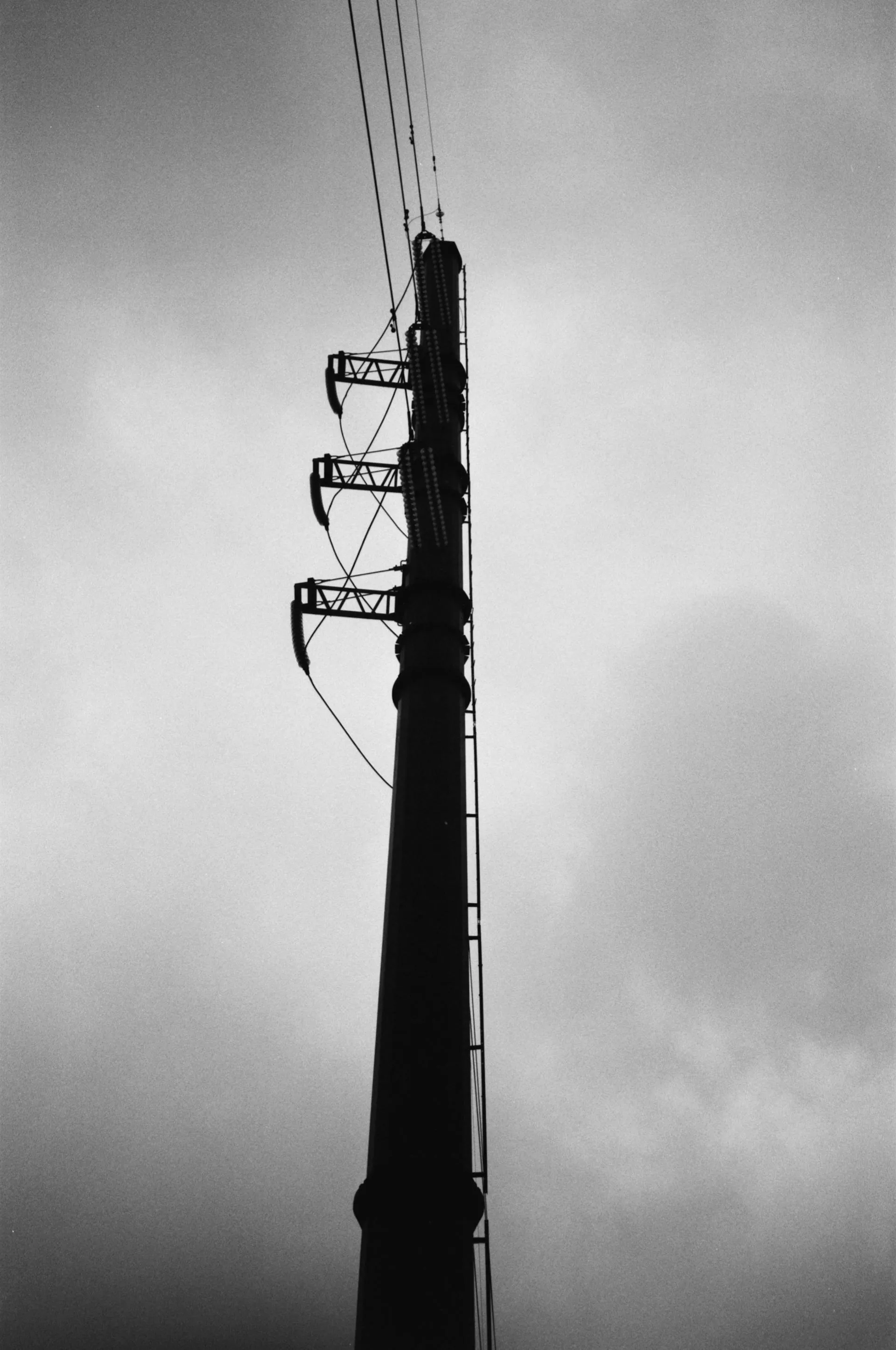
Multiple bare wires (typically 3) on cross-arms running pole-to-pole down the street. These are the high-voltage feeder lines that bring power into a neighbourhood. Larger clearance distances apply. You and your contractor stay well clear.
Low-voltage mains
Bare or aerial bundled cables (ABC) running pole-to-pole at house-eaves height. These distribute to individual properties. Bare low-voltage lines have meaningful clearance requirements; ABC (insulated, bundled) lines have a smaller required clearance — fully insulated powerlines such as ABC always require a clearance zone of 10 cm.
Service lines
The line from the street pole down to your eaves/connection point. This is your responsibility. It can be a single insulated cable, a triplex (three-conductor) bundle, or an older bare conductor. The closer to your house, the more likely tree branches are catching on it.
If you don’t know which is which, take photos and ask the arborist. A qualified arborist working around lines can identify them on sight; an unqualified contractor is the wrong person to be guessing.
What you can and can’t do near a powerline
Two things matter: clearance distances during work, and clearance distances around live lines as a default.
Working distances when cutting
SAPN publishes safe working distances for vegetation work near powerlines. The summary:
- Hand tools: safe working distance 1 to 3 metres, varying by powerline type and voltage. Lower-voltage insulated lines allow closer work; bare high-voltage lines require the full 3 m.
- Power tools (chainsaw, pole saw, hedge trimmer): safe working distance 3 metres for all voltages. No exceptions.
- Closer than the safe distance: only qualified line workers or specialist arborists with appropriate training, PPE and a de-energisation arrangement can work inside the clearance zone.
Standing clearance (vegetation grown around lines)
The required clearance varies by voltage, span length, and whether the property is in a bushfire risk area. Larger clearances apply in bushfire risk zones because the consequence of arcing is higher. Fully insulated powerlines (ABC) always require a 10 cm clearance zone.
Why DIY is the wrong move
Even an experienced gardener with a chainsaw is the wrong person for this work. Risks:
- Direct contact with the conductor — at low-voltage 240 V that’s lethal; at 11 kV mains it’s catastrophic.
- Arc-over — high-voltage lines can arc through air at distances closer than the safe working distance, even without contact. The arc can ignite vegetation and cause flash burns.
- Branch movement — a partially severed branch under tension can swing or whip into a line.
- Falling branch — a section dropped without rigging can fall into a line below.
Specialist line-clearance arborists work with insulated tools, line-rated PPE, and where the work requires it, an arrangement with SAPN to de-energise the line. The training is specific.
When SAPN does the clearance for free
SAPN runs a Tree Trimming Program. The summary:
- SAPN is required by legislation to inspect and clear vegetation from around powerlines at regular intervals of no more than three years, in both bushfire and non-bushfire risk areas.
- Trees and branches around the public mains — the lines running down the street, across reserves, and over public road carriageway — are SAPN’s responsibility, and the program cost is recovered through network charges, not direct billing to the property owner.
- SAPN inspectors visit, schedule the work, and contractors do the cutting — typically without an outage where the work can be done with insulated tools, with a scheduled outage where it can’t.
When SAPN does the work, you may receive a notice (a postcard or letter) ahead of the planned trim. The work happens at the SAPN program’s pace, not on your timeline.
When you pay
SAPN’s program covers public mains, not everything. You pay when:
The line is a private service line
The service line from the street pole to your house is your asset (or in some cases the property’s asset). Vegetation clearance on that line is your responsibility. An arborist with line-clearance training does the work. SAPN can attend for de-energisation where the cut requires it; the de-energisation may attract a fee.
The tree is on your land and SAPN says you should have managed it
Where a tree on your private property has grown into the public mains and SAPN has to address it as part of the program, the property owner can be billed for the clearance — particularly if the tree had been growing toward the lines for years and the owner failed to manage it.
The work is removal, not just clearance trimming
SAPN’s program covers maintenance trimming to keep vegetation out of the line clearance zone. It doesn’t cover full tree removal. If your tree needs to come out — particularly a regulated tree under the PDIA rules — that’s a separate job, lodged through PlanSA where required, performed by a specialist arborist with a SAPN coordination arrangement. See the Adelaide tree removal permits guide for the regulatory framework and our large gum tree removal cost guide for the cost overhead a powerline-adjacent removal carries.
How a powerline-adjacent removal actually runs
A specialist arborist removing a tree near or under powerlines works through a defined sequence:
1. Site assessment and SAPN coordination
Before any cut, the arborist contacts SAPN to confirm the line type, the voltage, and whether de-energisation is required. For straightforward jobs with insulated tools and adequate clearance, no outage is needed. For a tree growing into bare high-voltage mains, a scheduled outage is the usual approach.
2. Scheduled outage where required
SAPN schedules the outage, notifies neighbours, and switches off the line for the work window. Outages are typically 4–8 hours; longer windows are arranged for larger jobs. The cost overhead is significant — outage scheduling, the SAPN attendance, and the arborist’s premium rate for line work all sit on top of a standard removal fee.
3. Sectional dismantling with rigging
The tree comes down in pieces, rigged to control descent. No section drops freely near a line. The work is methodical — small cuts, controlled lowering, every piece accounted for.
4. Cleanup
Standard cleanup applies — chipping the brush, removing logs, raking the ground. Where a kerbside or carriageway has been temporarily closed for the work, traffic management is reinstated.
5. Cost overhead
A removal that would run $1,500–$2,500 on an open block typically runs $2,500–$5,000+ when powerline coordination is required. The premium reflects the SAPN attendance fee, the specialised gear, the slower work pace, and the insurance position.
For the broader cost framework on large gum tree removal — which often involves powerline considerations — see our large gum tree removal cost guide.
Storm season — fallen branches on lines
In storm season, branches on lines are common in Adelaide. The protocol:
- Never approach a fallen line or a branch on a line. Treat every line as live.
- Keep at least 10 metres clear of any fallen line.
- Call SAPN on 13 13 66 to report a downed line, a branch on a line, or any safety risk involving the network.
- Call SES on 132 500 if there’s broader storm damage to the property — tree on house, structural damage, water ingress.
- Don’t move debris until SAPN has confirmed the area is safe.
If a tree on your property has fallen onto a service line or mains line, our tree fallen on house guide covers the broader emergency-response sequence.
Frequently asked questions
Who removes a tree branch on a powerline in Adelaide? For the public mains (the lines down the street), SAPN handles clearance under its three-year inspection program — generally without cost to the property owner. For a private service line (from the street pole to your house), the property owner pays a specialist arborist with line-clearance training. Storm-related fallen branches on lines: call SAPN on 13 13 66.
Is SAPN powerline tree removal free? Maintenance trimming around the public mains is generally covered under SAPN’s regulated tree-trimming program, with no direct cost to the property owner. Full tree removal is not — that’s a separate job at the owner’s cost. Trees on your property that have grown into the mains can sometimes be billed back to you if SAPN takes action and the tree was your responsibility to manage.
How close can a tree be to a powerline? Required vegetation clearance varies by voltage, span length and whether the area is in a bushfire risk zone. Fully insulated lines (ABC) require 10 cm clearance. Bare low-voltage lines need more. Bare high-voltage lines need significantly more, with the largest clearances in bushfire risk areas. Check SAPN’s clearance distances for your line type and area.
Do I need SAPN to turn the power off to cut a branch? Sometimes. For work where the safe working distance can be maintained with insulated tools, a de-energisation isn’t needed. For bare high-voltage lines, or where the work has to happen inside the safe distance, a scheduled outage and an arborist with line-clearance qualifications is the only legal way. The arborist arranges this with SAPN.
What if a tree falls on a powerline? Stay clear — at least 10 metres. Call SAPN on 13 13 66 to report the downed line. Don’t approach the tree, the line, or any debris contacting the line. If there’s broader storm damage to a property, also call SES on 132 500. SAPN will dispatch a crew to make the line safe before any tree work happens.
Sources
- SA Power Networks — Vegetation around powerlines
- SA Power Networks — Responsibilities around tree trimming and planting
- SA Power Networks — Tree trimming program
- SA.GOV.AU — Safe clearance distances between vegetation and powerlines
- LGA SA — Submission on SAPN Vegetation Management Protocol 2024–27
- SA Country Fire Service
This guide reflects SAPN’s published vegetation-management protocols and SA’s regulated clearance framework as we understand them on 5 May 2026. Required clearance distances and program procedures are updated by SAPN — confirm against the current SAPN guidance for any specific job. Emergency numbers: SAPN faults and emergencies 13 13 66, SA SES 132 500.