Tree Fox · Adelaide arborists
Tree Fallen on House Adelaide — 24-Hour Action Plan & Who to Call
By Tree Fox · Published 5 May 2026
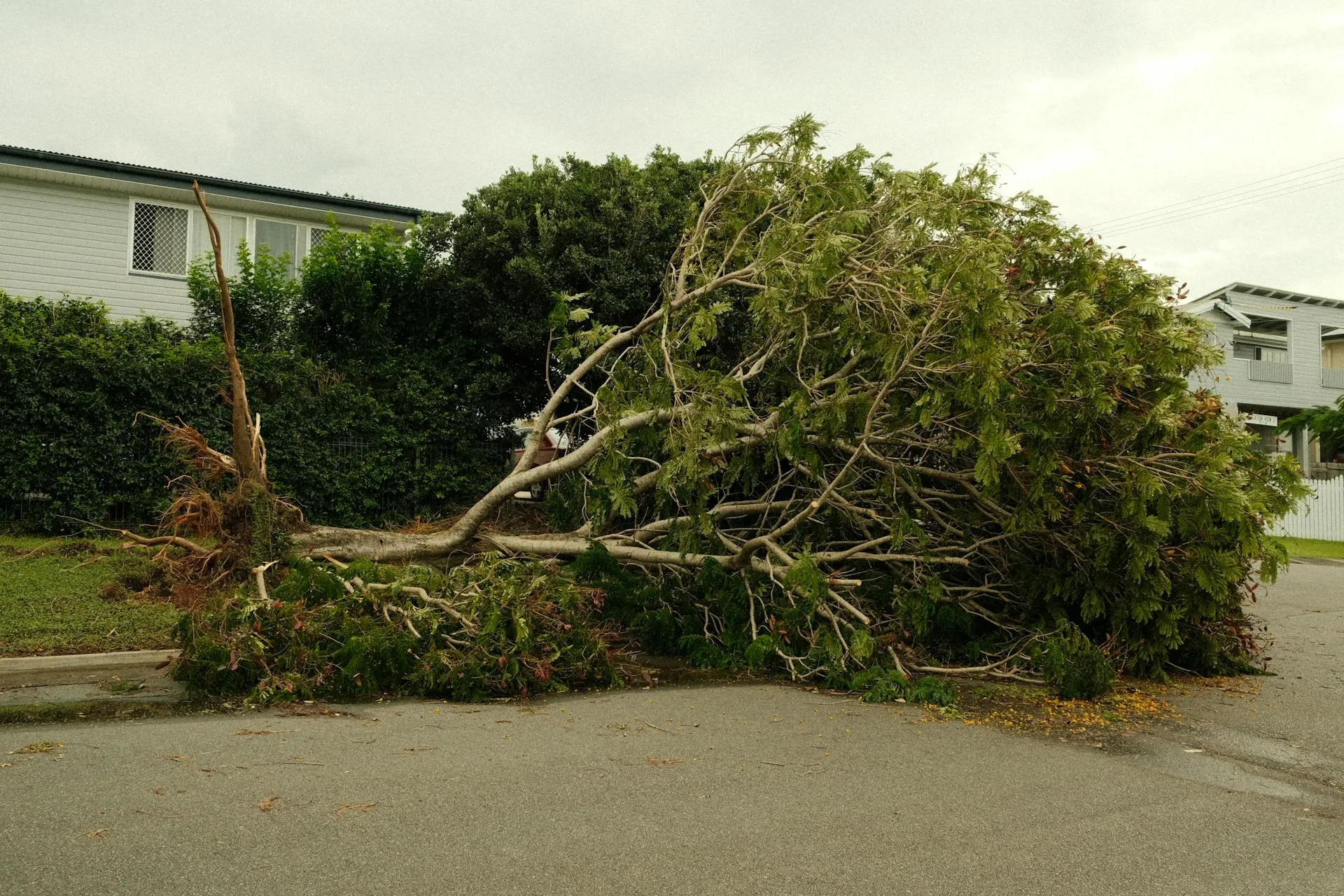
What to Do When a Tree Falls on Your House in Adelaide — A 24-Hour Action Plan
Last updated: 5 May 2026.
If a tree has just fallen on your house in Adelaide, the order of operations is: get everyone out of the impact zone, call Triple Zero (000) if anyone is injured or trapped, then call SA SES on 132 500 if there’s structural damage to the house or roof, or a tree blocking your only exit. Don’t go onto the roof. Don’t try to cut anything yourself. Don’t go near fallen powerlines. Photograph what you can safely see from the ground, then call your home insurer to lodge a claim and an emergency arborist for the make-safe.
That’s the next ten minutes. The rest of this article walks through the first hour, the rest of the day, and the days that follow — the insurance side, the council side, what an emergency arborist actually does on site, and the decisions you’ll need to make as the dust settles.
This is a long page because the situation is stressful and the small details matter. The summary at the top is the only thing you need right now. Everything else can wait.
First 60 seconds — what to do right now
- Get everyone out of the impacted rooms. Move to the safest part of the house, away from the impact zone. If the structural integrity feels uncertain, leave the house entirely.
- Call 000 if anyone is injured, trapped, or there’s a fire risk. Don’t second-guess this.
- Call SA SES on 132 500 if the tree has caused structural damage to your roof or walls, or if it’s blocking access in or out. SES is the right number for a tree that’s hit a structure. (Source: SA SES.)
- Stay clear of any fallen powerlines, including small service lines from the pole to your house. Treat every line as live. Call SAPN on 13 13 66 to report and stay 10 m back.
- Don’t go on the roof. Don’t cut anything yourself. Don’t move debris off a damaged structure.
- From the ground, photograph the tree, the damage, and the surrounds. Wide shots first, then closer detail. Date-stamped photos from your phone are fine.
- Call your home insurer. Most have a 24-hour storm-event line. They’ll guide you through lodging the claim and authorise emergency make-safe work.
That’s the priority order. Everything below explains why in case you have time for the why.
Why SA SES, not Triple Zero, for most tree-on-house calls
A common moment of hesitation: do I call 000 or 132 500? The split is straightforward.
Call Triple Zero (000) if there’s:
- An injury that needs an ambulance.
- Anyone trapped inside the house or under debris.
- A fire, gas leak, or smell of gas.
- Any active life threat.
Call SA SES on 132 500 if:
- A tree has fallen on your house, garage, shed, carport, or vehicle and caused structural damage.
- A tree or large branch has fallen and is blocking your driveway or access point so you can’t enter or leave.
- A roof is leaking significantly because of storm damage.
- The damage isn’t life-threatening but the structure isn’t safe.
(Source: SA SES — When to Call 132 500.) The SES is a volunteer-staffed service and they’re the right resource for storm-damage stabilisation: they’ll attend, assess, tarp roofs, secure structural damage, and clear immediate access where they can. Their service is free.
What SES won’t do:
- Remove a tree that fell on a structure but isn’t causing immediate access or safety problems (that’s an arborist job once stabilisation is sorted).
- Remove a tree from a footpath, public road, or park (that’s the local council’s job — find them via the LGA SA Councils page).
- Cut up debris on private property unrelated to a damaged structure.
If the tree’s down across your back lawn but missed the house entirely, that’s a job for an arborist when you’re ready, not an SES call-out.
The first hour — safety, stabilisation, and the people you need to talk to
Once you’ve made the immediate calls, the next hour is about not making the situation worse.
Stay out of the impact zone
A tree resting on a roof is rarely stable. The branch you can see may be the only thing holding the rest off the ground. Walking under it, going onto the roof to “see how bad it is,” or moving debris around the base can cause a secondary collapse.
The same applies to a tree leaning on a garage, a fence, a powerline, or a vehicle. Until a professional has assessed the load and stabilised it, treat the area within the tree’s reach as off-limits.
Don’t approach fallen powerlines
This is non-negotiable. SA Power Networks’ guidance is clear: stay at least 10 metres back from any fallen line, including service lines from the pole to your house. Lines can re-energise unexpectedly, and the ground itself can carry a step-potential charge near a downed line. Call SAPN on 13 13 66 immediately to report any line on the ground or in contact with the tree.
If your power has gone out and you can see the line is down, do not try to switch the mains off at your meter box if it requires walking near the line. Get clear; the line takes priority.
Document everything before any cutting starts
This is for your insurer. Before SES, an emergency arborist, or anyone else starts work, your phone is your best ally. Take:
- Wide shots showing the whole tree, the damaged structure, and the relationship between them (where the tree fell from, where it landed).
- Mid shots of the impact points — every wall, every roof line, every window the tree has touched.
- Close shots of any structural damage — cracked tiles, snapped rafters, broken glass, dented gutters, anything visibly compromised.
- A short video walking around the perimeter from the ground, narrating what you can see (“this is the lounge ceiling, you can see the rafter is exposed here”).
- Pre-storm photos if you have any. Insurers love a “this is what it looked like last week” reference.
If it’s after dark, do what you can with a torch and a flashlight. Photograph again in daylight when it’s safe to do so.
Lodge the insurance claim within the first 24 hours
The Insurance Council of Australia’s general guidance is clear: contact your insurer as soon as possible after a storm event, before you authorise any building work or emergency repairs. Most major Australian insurers have a 24-hour storm response line that’s staffed during weather events.
You don’t need a full damage assessment to lodge. You need:
- The policy number.
- A brief description of what happened and when.
- The address.
- Photos.
- Your contact details for the assessor.
The insurer will assign a claim number, often a make-safe authorisation, and either send their own assessor or accept yours. Note their guidance carefully: unauthorised work may not be covered. Don’t book a $4,000 emergency removal on the assumption the insurer will pay; talk to them first.
For the full picture on what your home insurance does and doesn’t cover for tree damage in Adelaide, see storm damage and tree insurance claims.
When to call an emergency arborist
The line between SES and an arborist is roughly: SES makes the structure safe enough to wait; the arborist takes the tree off.
You’ll usually need both, in that order. SES will tarp a damaged roof, prop a wall, secure a damaged carport, or clear immediate access. They won’t cut up the tree itself in any depth. Once SES has cleared the scene and the structure is stable, the arborist’s job begins.
You’d call an emergency arborist directly (skipping SES) only if:
- The tree is on a structure but not causing structural damage — say, a large branch resting on the gutter line of a flat carport with no roof penetration.
- The tree is blocking your driveway but the house is undamaged.
- The tree’s down on a garden bed or fence and there’s no impact zone risk.
A good Adelaide emergency arborist will be on site within 2–6 hours of the call during business hours, longer overnight or during a major storm event where every operator is at capacity. Storm peak (June–September) is the busiest period and even good operators run waiting lists during a major event.
Our after-hours line is on the storm damage and emergency removal page. The single CTA at the foot of this article goes there.
What an emergency arborist actually does on site
The first visit isn’t always the full removal. Storm-damaged trees on structures usually run as a two-stage job: make-safe, then full removal.
Make-safe (the same day or next day)
This is the priority work. The arborist’s job is to:
- Assess load and stability. Where is the tree resting? What’s holding it up? Is there secondary collapse risk?
- Stabilise the tree. Sometimes that means strapping a section to prevent further movement. Sometimes it’s removing a small piece that’s threatening to drop.
- Cut sections that can’t safely wait. Limbs over a damaged roof, broken sections under tension, anything actively threatening to cause more damage.
- Tarp, brace, prop where needed. Usually in coordination with what SES has already done.
- Document everything. Photos for the insurance file, a written make-safe report.
A make-safe visit on a tree-on-house in Adelaide usually runs $500–$2,500, depending on the size of the tree, the access, the time of day, and the complexity of the load. Major events or after-hours work pushes the upper end. Insurance generally covers make-safe in a covered claim, but confirm authorisation with your insurer first.
Full removal (within days, not hours)
Once the structure is stable and the insurance claim is moving, the arborist returns for the controlled, sectional dismantling. This is slower, more careful work — typically a half to full day for a large tree on a house — and it includes:
- Sectional dismantling of the canopy over the damaged structure.
- Crane assistance where the tree is too big to dismantle by climber alone.
- Roof and structure protection (tarps, plywood, padded skids).
- Disposal of all green waste and timber.
- Stump grinding if requested (usually a separate line — see stump grinding cost in Adelaide).
Total full-removal cost depends on the tree. A medium tree on a single-storey roof might be $2,000–$4,000. A 20 m sugar gum across a heritage-cottage roofline can be $6,000–$12,000+ with crane.
These are not numbers you should be paying out of pocket on a covered storm claim. Talk to the insurer’s assessor about scope and pricing before authorising the full removal.
Council approval — yes, even for fallen trees
A surprise that catches a lot of homeowners after a storm: even a fallen tree can be a regulated or significant tree under PlanSA’s rules, and removing what’s left of it without approval can be an offence.
The good news: PlanSA recognises an emergency removal exemption for trees that are an immediate threat to life or property. A tree that’s fallen on or into a house clearly qualifies. You don’t need to apply for council approval before stabilising and removing the immediate threat.
The detail: you should still document that the tree was a regulated or significant specimen before removal, retain the make-safe photos and the arborist’s report, and notify your council in writing within a reasonable period (most councils want notification within 14 days). Some councils may require replacement plantings.
If the tree is partly down — for example a major limb has failed but the trunk is still standing — that’s a different conversation. The trunk might need formal council approval to remove if the tree is regulated and the remaining structure is stable. Don’t assume “the storm broke it” gets you out of the application. Talk to the arborist about the right scope.
For the full picture on regulated trees, see our tree removal permits in Adelaide guide.
What insurance generally covers (and what it doesn’t)
This is a high-level summary. For the detailed walk-through, see our storm damage and tree insurance claims article.
Generally covered under most Australian home and contents policies:
- Damage to your house and outbuildings caused by a storm-fallen tree.
- Make-safe costs and emergency removal of the tree from the damaged structure.
- Repairs to roof, walls, ceiling, glass, and other building elements damaged by the tree.
- Damage to contents inside the house caused by the tree (water ingress, ceiling collapse, broken windows).
Often not covered:
- Removal of the tree’s debris from the rest of the property if it’s not on a damaged structure.
- Removal of a tree that fell of natural causes (no storm event) onto your own property without damaging an insured structure.
- Preventative removal of a healthy tree, even if it “looks dangerous after the storm.”
- Damage from a tree that was already known to be dangerous and not addressed (the maintenance defence).
The neighbour’s tree on your house: as a general principle in Australia, your insurer pays for damage to your property and seeks recovery from the neighbour only if negligence is proven. A storm-felled tree is usually treated as an act of nature, so no negligence applies and your own policy covers it.
These are general principles. Every policy is different. Read your Product Disclosure Statement, talk to your insurer, and don’t take what a contractor or a website says as financial advice.
The next 7 days — what to expect
Day 1. SES make-safe. Insurance lodgement. Emergency arborist make-safe. Documentation.
Days 2–3. Insurance assessor visit (sometimes in person, sometimes desktop with your photos and the arborist’s report). Make-safe arborist returns with a quote for the full removal scope.
Days 3–7. Full removal scheduled. If the tree is regulated and a stand is partly remaining, council notification submitted. Builder/roofer engaged to start structural repairs (your insurer often manages this through their preferred-builder network).
Week 2 onwards. Stump grinding (if requested), debris cleanup, replanting plans (if a regulated-tree replacement is required by council), final invoicing through the claim.
This is the smooth version. Major events — like the kind of severe storms that have driven Australia’s $4.8 billion in insured losses across 2025 (per the Insurance Council of Australia) — push every step out. Demand for emergency arborists, builders, roofers, and assessors all spike at once. Patience helps. So does having a documented file.
What to do before the next storm
If you’re reading this after the fact: you’re already past this section. Skip it. Bookmark it for next year.
If you’re reading this as a precaution:
- Walk your property after every major storm. Look for split limbs, cracked unions, lifted root plates. See our how to tell if a tree is dangerous guide.
- Get a routine arborist inspection for any large tree near a house, especially eucalypts. An hour-long inspection costs $200–$400 and finds the problems — internal decay, root weakening, even termite damage in Adelaide homes at the base — that turn into next year’s emergency call.
- Photograph your trees and your property in fair weather. Insurers love a “this was the tree last summer” reference shot.
- Know your insurer’s storm-claim line before you need it. Save the number.
- Check your policy for any tree-removal exclusions specific to your provider. Some policies have removal-only sub-limits.
The Adelaide Hills, the foothills suburbs (Mitcham, Tea Tree Gully, parts of Burnside and Onkaparinga), and the older eastern-suburbs gardens carry the highest tree-fall risk. If that’s where you live, the prep matters more.
For Hills-specific risk and bushfire-overlay considerations, see our Adelaide Hills service page.
Frequently asked questions
Who do I call first if a tree falls on my house in Adelaide? If anyone’s injured or trapped, Triple Zero (000) first. If the tree has caused structural damage to the house or roof, or it’s blocking access in or out, SA SES on 132 500. Then your home insurer to lodge the claim, then an emergency arborist for the make-safe work. Don’t approach fallen powerlines — call SAPN 13 13 66 and stay 10 metres back.
Is the SES free? Yes. SA SES is a volunteer-staffed service and the make-safe response — tarping a damaged roof, propping structural damage, clearing access — is free. They don’t do the full tree removal; that’s an arborist’s scope and is paid work, generally covered by your insurance under a valid storm claim.
Will my insurance cover tree damage to my house? Generally yes for a storm event under a standard Australian home and contents policy — damage to the house, contents, and removal of the tree from the damaged structure are typically covered. What’s often not covered is removal of the rest of the tree’s debris from elsewhere on your property if it’s not on a damaged structure, preventative removal, or a tree that fell from natural causes (no storm event). Always lodge with your insurer before authorising work.
Do I need council approval to remove a fallen tree? PlanSA’s emergency removal exemption covers trees that are an immediate threat to life or property — which a tree on your house is. You don’t need pre-approval to make safe. You should document that the tree was regulated or significant before removal, keep the photos and the arborist’s report, and notify your council in writing within their notification window (typically 14 days). Replacement plantings may be required.
How quickly can an emergency arborist get to my house in Adelaide? Within business hours, 2–6 hours is typical. Overnight or during a major storm event, it can be longer because every operator is at capacity. Make-safe priority goes to structural-damage cases over green-waste-only cases. If the tree’s on the house, you’re at the front of the queue.
How much does emergency tree removal cost in Adelaide? Make-safe (the immediate stabilisation visit) typically runs $500–$2,500. Full removal of a tree from a damaged structure runs $2,000–$12,000+ depending on the tree size and whether crane assistance is needed. Both are generally covered under a valid storm-event home insurance claim, but confirm authorisation with your insurer before booking the work.
Do I need an arborist report for the insurance claim? Most insurers will accept the arborist’s make-safe report and quote for the work. Some claims, particularly disputed ones or larger structural damage, will ask for a formal AQF Level 5 arborist report. Your assessor will tell you if one’s needed. See arborist reports for what’s involved.
What if it’s a neighbour’s tree that fell on my house? Lodge the claim with your own insurer. As a general Australian-insurance principle, your insurer pays you for the damage and may pursue recovery against the neighbour’s insurer only if negligence (e.g. they were warned the tree was dangerous and did nothing) can be proven. Storm events are usually treated as acts of nature, so the negligence test isn’t met. Your insurer is your starting point, not your neighbour.
Sources
- SA SES — When to Call 132 500
- SA SES — 132 500 emergency assistance
- Insurance Council of Australia — Storms
- Insurance Council of Australia — Hail events push extreme weather costs to $4.8 billion in 2025
- PlanSA — Significant and regulated trees (emergency exemption)
Pricing and timing in this article reflect typical full-job quotes in Greater Adelaide as of May 2026 and are based on the operator’s quoting data. Insurance specifics vary by policy — talk to your insurer.