Tree Fox · Adelaide arborists
Jacaranda Pruning Adelaide — When to Prune for the Purple Show
By Tree Fox · Published 5 May 2026
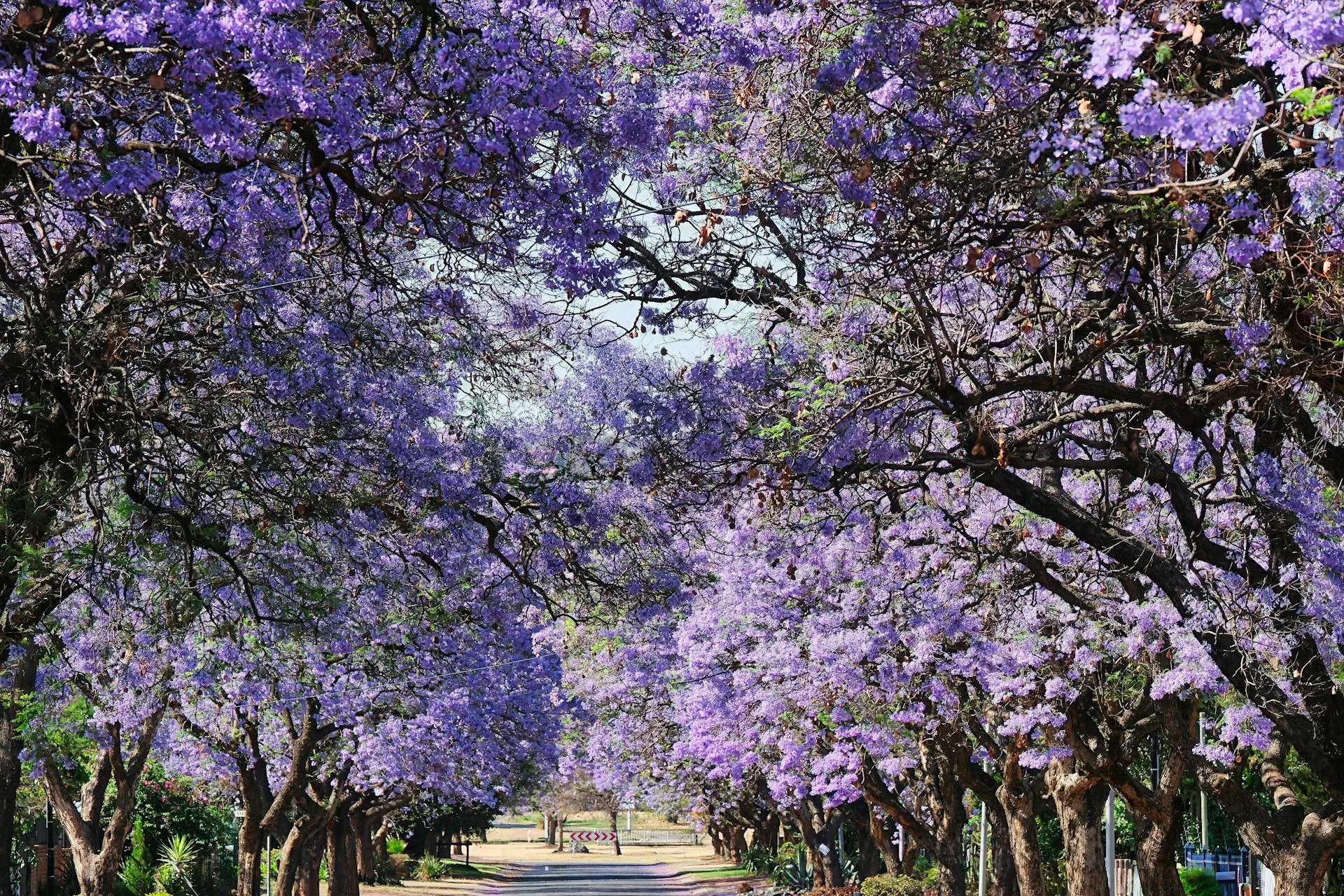
Jacarandas in Adelaide — When to Prune, How to Care, and What to Do When One Has to Come Down
Last updated: 5 May 2026.
Prune a jacaranda in Adelaide in January to March — after the purple flowers have dropped and before the tree sets next year’s buds. Prune it in winter or early spring and you cut off the bloom you were waiting for. The window is narrow, the rule is unforgiving, and it’s the single most-asked jacaranda question in the trade.
Adelaide’s jacaranda population is concentrated in the heritage character streets of Norwood, St Peters, College Park, Hyde Park, Walkerville and parts of Unley. They flower November to December (sometimes into early January in cooler years), drop the carpet of purple, leaf out, and set the buds for next year through summer. Disturb the cycle and the tree skips a year.
This guide covers timing, technique, the structural problems Adelaide jacarandas develop, the regulated-tree rules that apply once the trunk passes 1 metre around, and when removal is the right answer.
When to prune a jacaranda
The window:
| Job | Window | Notes |
|---|---|---|
| Annual shape and crown lifting | January – March | After flower drop; before bud-set |
| Deadwood removal | Any time | Dead is dead |
| Storm-damage cleanup | Any time | Necessary work overrides timing |
| Hard reduction | January – February | Earlier in window for more recovery time |
| Avoid completely | September – December | Cuts off the year’s bloom |
| Avoid completely | May – August | Cold-cut risk; loss of stored bud-energy |
The rule, in one sentence: light shape work, after flowering, every two to three years. Jacarandas don’t want or need an annual prune. They hold their natural form well; over-pruning produces a flush of vertical water shoots that don’t flower.
The seasonal calendar across all Adelaide species is in best time to prune trees in SA — jacaranda sits with the spring-flowering ornamentals in the “after flowering” group.
How to prune a jacaranda
The technique is light, structural, and minimal.
1. Take out the deadwood. Standard first move on any tree.
2. Remove crossing and rubbing branches. Two limbs grinding on each other create wounds that don’t heal. Take out the smaller one, or the one growing in a less useful direction.
3. Crown lift if needed. Removing the lowest branches to clear sight lines, paths, fences and parked cars. Common on Norwood and St Peters mature jacarandas planted close to the footpath.
4. Light tip-back on long pendulous laterals. Jacaranda branches grow long and droopy with age. A modest reduction (back to a strong outward-facing lateral) keeps the tree from sweeping the lawn or the car. No more than 20% of the canopy in a single prune.
5. Don’t top. Topping a jacaranda — cutting all the leaders to a uniform height — produces a flush of weak vertical water shoots that don’t flower for years and wreck the form. Same rule applies as on eucalypts: light reduction back to laterals, never lopping.
6. Don’t prune in cold weather. Even outside the bud-setting window, mid-winter cuts on jacaranda heal slowly and are vulnerable to dieback in cold snaps.
The amount: 15–20% canopy reduction is the working ceiling for a regular jacaranda prune. Heavy reduction beyond that is reserved for cases where the tree has structural problems (see below) and is best done as a phased multi-year project.
Why pruning at the wrong time costs you next year’s flowers
Jacarandas set their flower buds during summer — January through to April — on the previous season’s wood. The buds sit dormant through autumn and winter, then break in late spring (October–November) and flower November–December.
Prune in winter and you remove most of the bud-bearing wood. The tree leafs out, grows, and either skips flowering entirely the next season or flowers very lightly. The “I pruned my jacaranda in July and it didn’t flower” complaint is an annual fixture in Adelaide gardening forums.
Prune in early spring (September–November), as the buds are about to break, and you do the same damage with the additional cost of stressing the tree at the start of the active growing season.
The window is January to March. It’s narrow. It’s worth respecting.
Common jacaranda problems in Adelaide
The recurring structural issues:
Included bark at Y-unions. Jacarandas frequently develop two co-dominant stems leaving the trunk at a tight angle, with bark trapped inside the union instead of forming proper wood. The pattern is visible from the ground: a vertical seam running down from the union, often with a slight bulge above and a tapered notch below. Included-bark unions fail in storms — they’re the single most common storm-damage failure on Adelaide jacarandas. If you see one on a mature tree, get an arborist’s reduction plan.
Surface roots and hardscape lifting. Jacaranda roots are aggressive at the surface and will lift pavers, footpaths, brick edging and (occasionally) lightweight footings. The lifting usually appears 5–10 metres from the trunk in any direction. Root pruning to relieve hardscape damage is possible but has structural risk on mature trees — get arborist advice before cutting roots over 5 cm diameter.
Suckering from the rootstock. Most nursery-grown jacarandas are grafted onto seedling rootstock for vigour. Suckers from below the graft are usually leaf-out earlier than the canopy and produce no flowers. Remove them at the trunk, not at ground level, every spring.
Storm shedding. Even healthy jacarandas shed twiggy growth in summer storms. The pattern is normal and not a structural concern unless larger limbs are coming down — in which case the included-bark issue above is usually the cause.
Slow recovery from poor pruning. Once a jacaranda has been topped or hard-pruned, it takes 3–5 years to rebuild a flowering canopy. Inherited a “tidied” jacaranda from the previous owner? The slow rebuild is the only path; there’s no shortcut.
Frost damage on young trees. Jacarandas in Adelaide’s colder Hills suburbs (Stirling, Aldgate, Crafers) are vulnerable to frost damage in their first 5–10 years. Mature trees in the metro are generally fine; young trees in cold-air-drainage frost pockets aren’t. The metro plains and the warmer eastern foothills (Norwood, Burnside) are the natural Adelaide jacaranda range.
When a mature jacaranda is regulated
Standard SA framework applies. Once the trunk reaches 1 metre in circumference at 1 metre off the ground, the tree is a regulated tree under the Planning, Development and Infrastructure Act 2016. At 2 metres around, it’s a significant tree. A 30-year-old established jacaranda is usually well into the regulated band; a 60-year-old heritage tree is often significant.
The standard 3-metre dwelling exemption applies to jacarandas (unlike eucalypts) — a regulated jacaranda within 3 m of an existing dwelling or pool is exempt from the regulated-tree rules. Outside that 3 m band, the rules apply in full.
What’s exempt:
- Maintenance pruning up to 30% of the crown, no more than once every five years
- Deadwood removal
- Removal where the tree is dead or genuinely dangerous (with arborist documentation)
What needs a development application:
- Removal of a regulated or significant jacaranda outside the 3 m dwelling band
- Heavy reduction beyond 30% of the crown
- Most root work on a regulated jacaranda
The full regulatory framework — including the May 2024 reforms and the increased fines for unauthorised work — is in tree removal permits in Adelaide.
Council overlay considerations. NPSP and Unley both list specific heritage jacarandas on their respective heritage tree registers, and both have heritage character zone overlays that interact with tree work decisions. The NPSP permit guide has the council-specific detail. The Norwood location page covers the streetscape context.
When removal is the right answer
Most jacaranda problems are pruning problems, not removal problems. The cases where removal is genuinely the right call:
Storm-damaged tree beyond reduction. A jacaranda that’s lost a major scaffold limb to an included-bark failure, where the remaining structure is unbalanced and unsafe, sometimes can’t be saved with reduction work. An arborist can call this — get the assessment before deciding.
Roots into a structure. Hardscape lifting can usually be managed. Roots into building footings is different — once a jacaranda has compromised a slab or footing, root barriers and selective pruning don’t reliably fix the problem and removal becomes the realistic option.
Decline beyond recovery. Mature jacarandas occasionally enter a decline pattern — progressive crown thinning, dieback that doesn’t respond to deadwood removal, sparse leaf-out the following spring. By the time more than half the crown is dead, the tree is past saving.
Wrong tree wrong place. A jacaranda planted 1.5 m from a paved courtyard 30 years ago is now a structural conflict. Reduction won’t change the geometry. Removal followed by a more appropriate replacement species is the long-term answer.
For removal — including the council application — see tree removal. For a structurally compromised but saveable jacaranda, an arborist’s reduction plan is usually cheaper and preserves the streetscape value.
FAQs about jacarandas in Adelaide
When should I prune my jacaranda? January to March, after the flowers have dropped and before the tree sets next year’s buds. The window is narrow but firm — pruning earlier or later costs you the next year’s bloom or stresses the tree at bud-break.
Can I prune a jacaranda in winter? You can but you shouldn’t. Winter pruning of a jacaranda removes most of the bud-bearing wood (the buds are set on the previous summer’s growth) and the tree skips or reduces flowering the next season. Mid-winter cuts also heal slowly in cold weather. If you absolutely must prune in winter — for safety reasons, for example — accept that next year’s flower display will be reduced.
Why didn’t my jacaranda flower this year? Three common causes. First: it was pruned at the wrong time (winter or early spring). Second: it’s young — jacarandas don’t flower reliably until they’re 7–10 years old. Third: extreme weather — a hard frost during bud-set or an unusually cool spring can disrupt flowering even on healthy mature trees.
Are jacarandas protected in Adelaide? A jacaranda becomes a regulated tree when its trunk circumference passes 1 metre (measured 1 metre above the ground), and a significant tree at 2 metres around. The standard “within 3 metres of a dwelling” exemption applies — jacarandas aren’t on the species-specific exclusion list (eucalypts and willow myrtles are). Some heritage jacarandas in NPSP and Unley are individually listed on council registers and protected regardless of the standard rules.
How tall do jacarandas get? Adelaide jacarandas typically reach 8–15 metres at maturity, with a comparable spread. The tallest mature heritage trees in Norwood and St Peters reach 15–18 metres. Growth rate is moderate — 30–60 cm a year on a healthy young tree.
Sources
This article is general guidance for jacarandas in South Australian conditions. For a regulated tree, get an arborist on site before any heavy work starts.