Tree Fox · Adelaide arborists
Palm Tree Removal Cost Adelaide — Real Prices by Species 2026
By Tree Fox · Published 5 May 2026
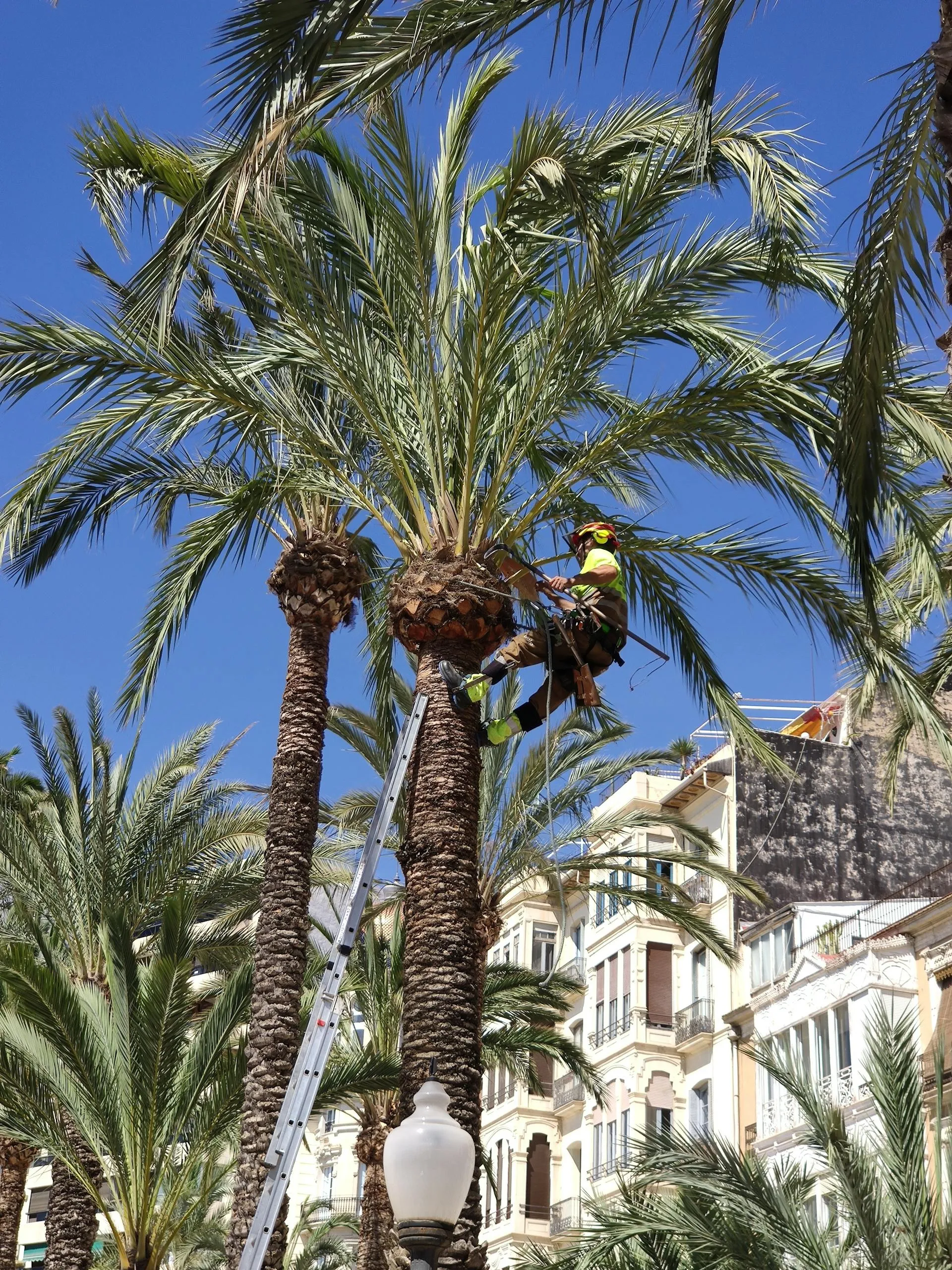
Palm Tree Removal Cost in Adelaide — Real Price Ranges by Species and Height
Last updated: 5 May 2026.
Most palm tree removals in Adelaide land between $350 and $900, depending on the height, the species, how easy it is to get a truck and chipper to the trunk, and whether you also want the stump out. A short Cocos palm in an open backyard sits at the bottom of that range. A 12-metre Canary Island Date palm with a thorny crown and a 1.5 m side gate sits at the top — sometimes higher.
That’s a noticeably tighter range than general tree removal, and the reason is structural. Palms aren’t trees in the botanical sense. They have no woody side branches to rope and lower, the trunk comes down in straight sections, and the green waste chips cleanly. If you’ve been quoted in the same band as a comparable-height eucalypt, the quote isn’t right. This article breaks down the real numbers by species, what actually moves the price, and where the “from $99 palm removal” ads stop being true.
For the broader cost picture across all tree types, see our tree removal cost in Adelaide guide.
Palm tree removal cost in Adelaide — quick reference
| Palm type and rough height | Typical Adelaide price | What this looks like |
|---|---|---|
| Small palm, under 4 m (Cocos, young Phoenix) | $350–$500 | Backyard ornamental, easy access, open drop zone |
| Medium palm, 4–8 m (Cocos, Cotton, mid Phoenix) | $500–$750 | Established backyard or coastal-suburb specimen |
| Tall palm, 8–12 m (Canary Island Date, mature Cocos) | $700–$1,100 | Mature feature palm, often needs an EWP |
| Very tall palm, 12 m+ | $1,000–$1,800 | Climber-and-crane work; clusters or row-removals priced individually |
| Stump removal (palm-specific) | $150–$450 add-on | Methods vary — see below |
| Multi-palm row (3+ palms in one visit) | Per-palm rate drops 10–25% | Truck and crew already on site |
These are full-job prices — climber or EWP, ground crew, chipper, debris removal, basic site cleanup. They are not “from $X” headline numbers. Your real quote depends on what we see when we walk the site.
Why palms are cheaper than hardwoods of equal height
A 10-metre eucalypt and a 10-metre palm are not the same job. The palm is faster, cleaner, and lower-risk for a few specific reasons.
No lateral branches. A eucalypt at 10 m has a canopy of woody side limbs that all need rigging, lowering, and chipping. A palm has a single trunk topped with fronds. The fronds come off first; then the trunk comes down in straight rounds.
Predictable felling sections. Once the crown is off, palm trunk sections are uniform cylinders. They cut to length, fall straight, and stack on the truck without much fuss. A eucalypt limb’s centre of gravity is anyone’s guess until you’ve cut it.
Lighter biomass per metre. The fronds chip beautifully. The trunk has more water than wood, especially in Cocos and Phoenix species. You don’t get the dense hardwood logs that turn a eucalypt removal into a two-day job for the chipper alone.
Lower rigging requirement. Most palms can be climbed and dismantled with a single climber, a basic groundie, and a chipper. The rigging spec for a comparable hardwood often pulls in an EWP or a crane.
The exception is the Canary Island Date. Those things are heavy, the fronds are spiked, and the crown holds a surprising amount of mass. A tall mature Phoenix canariensis is the upper end of palm pricing — and we’ll explain why below.
Price by palm species
Adelaide’s four common removal species each have their own quirks.
Cocos palm (Syagrus romanzoffiana, “Queen palm”)
The most-removed palm in Adelaide. Common across the western and coastal suburbs, often planted in clusters around 1980s–1990s pools and feature gardens, and now reaching the age where the seeds, the height, and the falling fronds are a problem.
- Short (under 5 m): $350–$500.
- Medium (5–8 m): $500–$700.
- Tall (8–12 m): $650–$900.
Cocos are the most predictable removal. Smooth trunk, light fronds, no thorns. Cluster jobs (three or four in a row in a pool surround) are quoted per-palm with the volume discount.
Canary Island Date palm (Phoenix canariensis)
The premium palm — and the premium price. Visually iconic across Henley Beach, Grange, and the older eastern-suburb gardens with deep front yards. Two things push the cost:
- The crown is dense. A mature Canary Date has dozens of long, heavy fronds with sharp basal spines that can pierce leather work boots. Crew has to rig and lower the crown carefully, and PPE goes up.
- The trunk is heavy. Phoenix canariensis is denser than Cocos at the same height; trunk sections weigh more, and the chipper hates the basal “pineapple” of old frond bases.
- Short to medium (under 8 m): $500–$800.
- Tall (8–12 m): $800–$1,300.
- Mature (12 m+): $1,200–$1,800+.
If you’re getting a Canary Date quote that matches a Cocos quote of the same height, the contractor either hasn’t seen one before or hasn’t priced the disposal properly.
Cotton palm (Washingtonia robusta)
Tall, skinny, and very common in the Adelaide foothills as a 1970s landscape feature. The classic “I planted this 30 years ago and now it’s 15 metres tall” call.
- Medium (5–10 m): $500–$800.
- Tall (10–15 m): $800–$1,300.
- Very tall (15 m+): $1,200–$1,800+.
Cottons aren’t physically heavy at the trunk for their height, but they sway, the climbing height alone pushes labour, and the dropped fronds are wide. Mature Cottons often need an EWP because the trunk gets thin enough at the top that climber-rigging is impractical.
Phoenix palm — Senegal date and others (Phoenix reclinata, P. roebelenii)
Smaller cluster-form palms popular in resort-style backyards. Often removed because the multi-trunk crown has outgrown the courtyard it was planted into.
- Small clump (under 4 m): $400–$650.
- Medium clump (4–6 m): $550–$800.
The cluster form means more individual cuts, more rigging, but smaller-section work overall. Stump grinding for Phoenix clusters is a separate conversation — see below.
What pushes a palm removal price up
The species and height set the band. These factors decide where in the band you sit.
Height beyond 8 m. Past 8 m the climber’s time on the trunk increases and EWP hire becomes more likely. Each additional 2 m of trunk above 8 m roughly adds 10–15% to the labour line.
Tight access. A palm in a courtyard you reach through a 1 m side gate is a different job than one in an open backyard. Every section of trunk has to be carried out by hand. A single Cocos with 50 m of carry can add $150–$250.
Proximity to structures. Palms over a tile roof, a glass sunroom, a pool, or paved entertaining area need rigging on every section. The cuts can’t free-fall. Add 15–25% to the labour.
Pool-side work. If the palm overhangs a pool, we cover the pool, drop nothing in the water, and clean any organics that do hit it. Coastal suburbs see a lot of this. Pool covers cost crew time. If the palm work is part of a larger pool surround refresh, get a parallel quote from Adelaide pool builders and spa installers — replanting and resurface decisions are easier with both quotes in front of you.
Crane requirement. Rare for palms but it does happen — usually for very tall Cottons over a structure, or a row of Canary Dates fronting a heritage facade. Crane day-rates start around $1,500–$2,500 in metro Adelaide.
Spiked species in PPE-heavy gear. Canary Date and some Phoenix species require puncture-resistant chaps, gauntlets, and face protection. The crew’s slower, the gear’s heavier, the pricing reflects it.
Stump removal in the same visit. Always cheaper than coming back. See the next section.
Disposal of organic debris. Palm fronds chip cleanly. Trunk sections don’t always — especially Canary Date with the fibrous “boot” of old frond bases. Some operators charge a tipping surcharge on Canary Date trunk loads.
What pushes a palm removal price down
Open backyard with vehicle access. Truck and chipper at the trunk, no carry, no fences to dismantle. The cheapest version of the same palm.
Stand-alone in a clear drop zone. No structures within fall radius. Larger sections, fewer cuts, less rigging.
Multiple palms in one visit. A row of three Cocos in a pool surround is roughly 2.4× a single-palm price, not 3×. The truck, the crew, and the chipper are already there.
Owner keeps the trunk rounds. Some clients use Cocos trunk sections as garden borders or rustic seating. Saves a tipper trip; small discount.
Off-season booking. Palm removal demand spikes after coastal storms (June–September) and ahead of summer. Late autumn and early spring tend to be quieter and quotes are slightly softer.
Palm stump removal — different rules from hardwood stumps
Most of what’s true for grinding hardwood stumps doesn’t apply to palms. Palm stumps don’t have a hardwood root flare; they have a fibrous root mat and a soft, water-heavy base. There are three options, and they each cost differently.
Grinding (where the operator will). Some operators won’t grind palm stumps at all. The fibrous material wraps the grinder teeth instead of cutting cleanly, the bog of wet pulp is messy, and a tooth replacement bill at the end of the job can wipe out the margin. Operators who do it generally charge $200–$450 to grind a palm stump as an add-on, slightly more than a hardwood stump of the same diameter.
Excavation (the cleanest option for palms). Because palm root systems are shallow and contained, an excavator can lift the whole root ball out cleanly. This is the preferred method when the area is being relandscaped or paved. $300–$700 depending on stump size and access for a small excavator or skid-steer.
Cut low and cover. If the stump is in a lawn area and not in the way, the cheapest answer is to cut it flush with the ground and let it rot down naturally. Palm stumps decompose faster than hardwood — a Cocos stump cut flush will usually crumble within 18–36 months. $0–$50 beyond the removal price.
For more on stump pricing across all tree types, see stump grinding cost in Adelaide.
Council and species rules — most palms are exempt
Most palms in Adelaide are not on the regulated tree register. The four common removal species — Cocos, Canary Island Date, Cotton, Phoenix — are all listed by PlanSA as exempt species in most circumstances. That means:
- No development application fee.
- No arborist report for council.
- No 28-day waiting period.
There are three exceptions worth checking.
- Heritage zones and character overlays. A few council areas (parts of Adelaide City, Norwood Payneham St Peters) have streetscape protections that can apply to mature feature palms even where the species is otherwise exempt.
- Trees in road reserves. A palm in the verge between your front fence and the kerb is council property, not yours. You don’t get to remove it. Talk to the council.
- Protected non-listed palms. A handful of less-common palms (e.g. Bangalow palm in some contexts) aren’t on the standard exempt list. We’ll check the species against the current PlanSA register before we quote.
For the full regulated-tree picture see our tree removal permits in Adelaide guide.
Why “palm removal from $99” ads are misleading
You’ll see them on Gumtree, Facebook Marketplace, and the side of vehicles. They’re cherry-picker call-out specials, not full removals. The numbers usually mean one of three things:
- Frond cleanup only. They’ll take the dead fronds off and leave. Useful pre-summer maintenance, not a removal.
- Dead-frond skirting. The Canary-Date “trim” — clipping the dead skirt — without taking the palm down. Cosmetic work.
- Loss-leader callout. They turn up, point out everything they didn’t quote for, and the real number lands on your kitchen table.
A real palm removal in Adelaide is a fixed quote after we’ve seen the palm, the access, and the surroundings. The number on the quote is the number on the invoice.
Coastal and western suburbs — where most of our palm work happens
Palms cluster geographically in Adelaide. The western and coastal corridor — Glenelg, Henley Beach, Semaphore, Grange, West Beach, Brighton — has the highest concentration of mature feature palms, mostly Canary Island Dates and Cocos planted in the 1970s–1990s. We do most of our palm-removal work in this corridor and price accordingly.
The eastern suburbs see fewer palms but more Cottons in foothills gardens. The Hills sees occasional Cottons in 1970s–1980s landscapes. The northern and southern suburbs have a steady residential mix. None of these areas carry a regional price loading; the species and access drive the quote.
For the service-page detail, see palm tree removal. For ongoing palm care without removal, see palm tree pruning in Adelaide.
Frequently asked questions
How much does it cost to remove a palm tree in Adelaide? Most palm tree removals in Adelaide cost between $350 and $900. Short Cocos palms run $350–$500, mid-height palms $500–$750, and tall Canary Island Dates or Cotton palms $700–$1,100. Very tall mature palms over 12 metres are quoted individually, generally $1,000–$1,800. Stump removal is a separate add-on of $150–$450.
Why is my palm quote $400 but my neighbour’s was $800? Species, height, and access. A 4 m Cocos in an open backyard is genuinely a $400 job. An 8 m Canary Date next to a tile roof with a 1.2 m side gate is genuinely an $800 job, even though the height and the suburb are similar. Ask each contractor what’s included — most quote variance is access, proximity to structures, or whether stump removal is in scope.
Do I need council approval to remove a palm in Adelaide? For the four common species (Cocos, Canary Island Date, Cotton, Phoenix), almost never. They’re listed as exempt on the PlanSA regulated trees register. Exceptions: palms in council road reserves, palms in some heritage character zones, and a handful of less-common palm species not on the standard exempt list. We’ll confirm the species before quoting.
Can the stump be removed too, and what does it cost? Yes, three ways. Grinding ($200–$450 add-on, where the operator will grind palms — some won’t), excavation of the whole root ball ($300–$700, cleaner result), or cut-flush-and-let-rot ($0–$50, takes 18–36 months). Excavation is the best option if the area is being landscaped or paved.
Are tall palms more expensive? Yes. Past 8 metres, climbing time, EWP hire likelihood, and rigging requirements all go up. A 12 m Cotton palm is roughly 1.7–2× the price of a 6 m Cotton because of the additional climbing and the EWP. A 15 m mature palm typically needs a crane or a long-reach EWP and lands at $1,200–$1,800+.
Why does the crown of a Canary Date cost more to remove? The fronds carry sharp basal spines that can puncture leather work gear, so the crew works in heavier PPE and slower. The crown itself is dense and the basal “pineapple” of old frond stubs jams chippers. It’s a slower, more careful job than a Cocos crown of the same diameter.
Sources
- PlanSA — Significant and regulated trees (exempt species register)
- SA.GOV.AU — Regulated and significant trees
Pricing in this article reflects typical full-job quotes in Greater Adelaide as of May 2026 and is based on the operator’s quoting data. Your real quote depends on a site visit.