Tree Fox · Adelaide arborists
Palm Tree Pruning Adelaide — Cocos, Date, Cotton & Phoenix
By Tree Fox · Published 5 May 2026
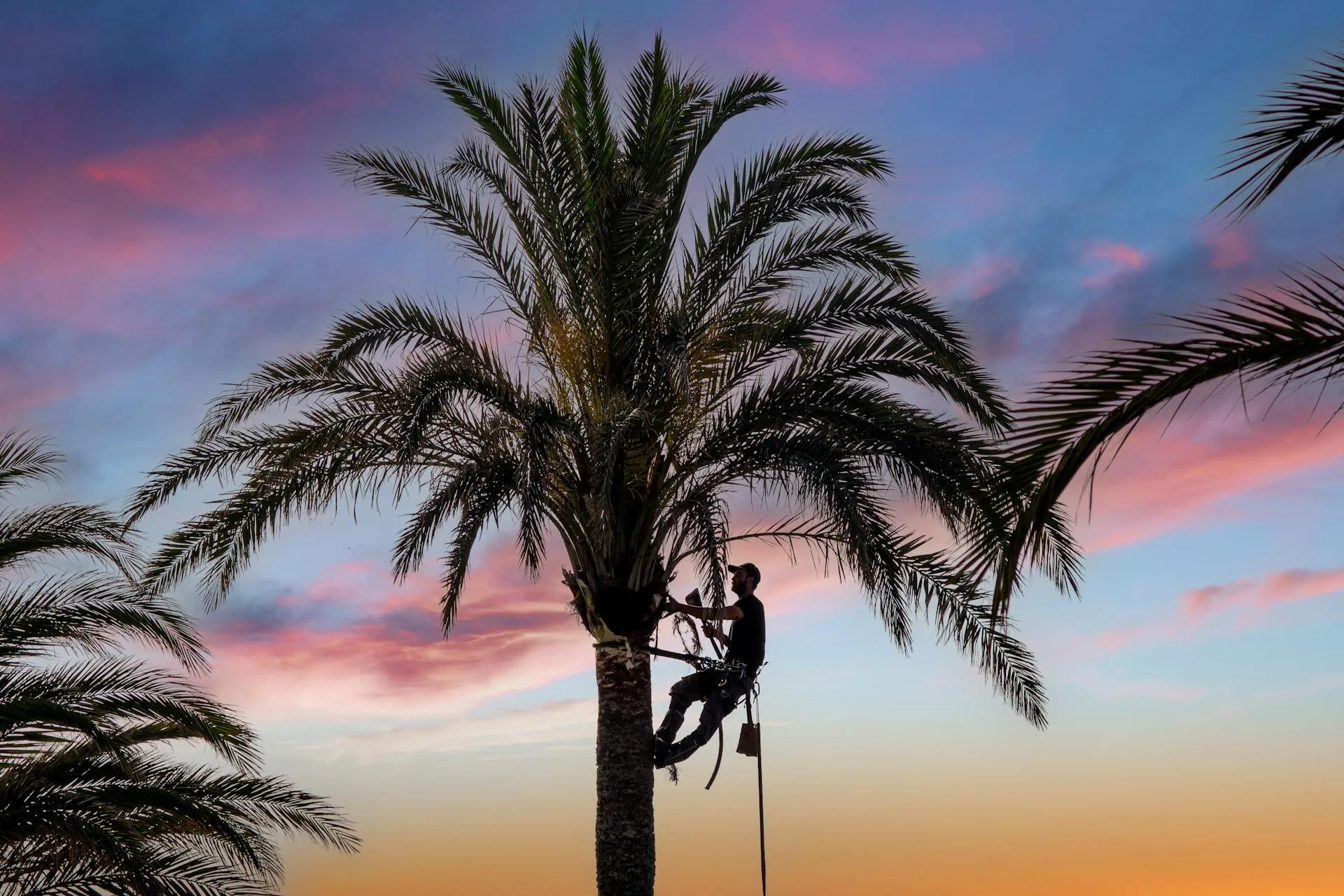
Palm Tree Pruning in Adelaide — A Practical Guide for Cocos, Canary Date, Cotton and Phoenix Palms
Last updated: 5 May 2026.
Palm tree pruning in Adelaide is frond removal, not crown shaping. You take off dead, yellow and hanging fronds, the old inflorescences and seed pods. You don’t cut into the green crown. The palm doesn’t have buds you can prune back to like an ordinary tree — it has one growing point at the top of the trunk, called the apical meristem, and if you damage it the palm dies. That single rule explains every Adelaide palm-pruning best practice and every bad-practice horror story.
This guide covers timing (almost any time of year — palms are flexible), the four palm species you’ll actually see in Adelaide gardens, why “hurricane cutting” is wrong, the safety problem with DIY palm work, and the quiet disease risk that good arborists worry about and bad ones don’t.
When to prune a palm
Almost any time of year. Palms don’t have a dormant season the way deciduous trees do, and the drivers for timing on amenity trees — bud-set, frost protection, sap rise — don’t apply. The practical timing rules:
| Trigger | When |
|---|---|
| Dead or yellow fronds appearing | Whenever they show up |
| Old seed pods or inflorescences | Before they shed seed onto paving |
| Pre-storm cleanup | Late autumn (April–May) before the June–September storm window |
| Routine maintenance | Annual or biennial visit, scheduled at owner convenience |
| Avoid | Hot windless afternoons (climbing safety); high fire-ban days |
The flexibility is genuine. A palm that needs deadwood removed in February can be pruned in February without horticultural penalty. The constraints are operator safety and access, not tree biology.
The four palm species you’ll see in Adelaide
Adelaide’s palm population is concentrated in the coastal western suburbs (Glenelg, Henley Beach, Brighton, Grange) and in older established gardens across the metro. Four species dominate:
Cocos / Queen palm (Syagrus romanzoffiana)
- Form: single straight grey trunk, smooth and ringed, 8–15 m tall at maturity. Crown of arching feathery fronds.
- Fronds: pinnate (feather-shaped), 2–3 m long, drooping gracefully.
- Where you see them: common in 1980s–2000s landscaping across Adelaide; coastal and inland.
- Watch for: heavy seed loads (orange dates that drop and stain paving); palm seedlings popping up in nearby garden beds.
Canary Island Date palm (Phoenix canariensis)
- Form: thick, heavily-textured trunk patterned with old leaf scars, 10–20 m at maturity. Massive crown of rigid feathery fronds.
- Fronds: pinnate, 4–5 m long, stiff with sharp basal spines that can puncture skin and cause infections — they’re the most dangerous frond bases in the trade.
- Where you see them: older heritage gardens in Glenelg, Brighton, North Adelaide, Walkerville; civic plantings; some Holdfast Bay streetscapes.
- Watch for: fusarium wilt (see disease section below); the spine puncture risk on the climber.
Cotton Palm / Mexican Fan (Washingtonia robusta)
- Form: tall slender trunk, 15–25 m at maturity. Crown of fan-shaped fronds.
- Fronds: palmate (fan-shaped), 1.5–2 m wide, with serrated petioles. Drooping dead fronds form a “skirt” if not removed.
- Where you see them: the tall fast-growing palms that became fashionable in the 1990s and now tower over many older gardens. Common across the metro.
- Watch for: the dead-frond skirt is a fire hazard and a rat habitat; height management is the main reason these palms get a lot of pruning attention.
Phoenix / Senegal Date palm (Phoenix roebelenii and related)
- Form: smaller multi-trunked palms, 2–4 m. Pygmy date palm is the most common.
- Fronds: pinnate, 1–1.5 m long, fine-textured.
- Where you see them: garden specimens, courtyard plantings, pool surrounds. Common in 2000s–2010s landscaping.
- Watch for: the basal spines (less severe than Canary Island date but still puncture-grade); susceptibility to potassium deficiency in Adelaide’s alkaline soils (yellow-tip frond pattern).
If you’re unsure what species you have, the trunk shape and frond type narrow it down quickly: ringed thin trunk + feathery drooping fronds = Cocos; thick patterned trunk + stiff feathery fronds = Canary Island date; tall slender trunk + fan fronds with skirt = Cotton/Washingtonia; multi-trunk small palm + fine feather fronds = Phoenix.
How NOT to prune a palm — “hurricane cutting”
The single most damaging thing you can do to a palm is the practice known as “hurricane cutting” or “over-pruning” — stripping the green fronds back to a tuft pointing straight up, leaving the palm looking like a feather duster.
Why it’s bad practice:
- Palms produce energy through their fronds. Removing green fronds removes the palm’s ability to photosynthesise. The palm responds by drawing on stored reserves to push the next round of fronds — slowly weakening the tree over years.
- The 9-and-3 rule. Modern arboriculture standards say no green frond should be removed below a horizontal “9 o’clock to 3 o’clock” line drawn through the crown. Anything above the horizontal stays. Anything below — already drooping or dead — can come off.
- Recovery is slow. A palm produces 8–15 new fronds a year. A hurricane-cut palm that has lost 30 fronds takes 2–4 years to recover full canopy.
- Pest and disease pressure rises. Stressed palms are more susceptible to ganoderma, fusarium and various scale insects.
- It looks bad. The aesthetic case alone should kill the practice.
The technique is sometimes sold as “preparing the palm for the storm season”. It does the opposite — a stripped palm has less wind resistance through reduced canopy, but the structural cost over years far outweighs the temporary storm benefit. Reputable Adelaide arborists won’t do it. If a quote includes “hurricane prune” or “skinning the palm”, get a second opinion.
Fusarium wilt and tool hygiene
The disease most arborists worry about on Adelaide’s Canary Island date palms is fusarium wilt (Fusarium oxysporum f. sp. canariensis). It’s a fungal disease specific to Canary Island date palms (and a few related Phoenix species). It’s lethal — there’s no cure — and it’s spread primarily by contaminated pruning tools.
The pattern:
- Symptoms start as one-sided frond death — the leaflets on one side of the rachis die while the other side stays green.
- A reddish-brown streak runs along the petiole on the affected side.
- The disease moves up the canopy from the older lower fronds to the newer upper ones.
- The palm dies over 1–2 years.
Tool hygiene is the only effective control. A fusarium-infected pruning saw moved between palms infects every palm it touches. The standard practice in Adelaide arboriculture for Canary Island date palms specifically:
- Disinfect the cutting blade between palms — 10 minutes in a 1:3 pine oil to water solution, or heat the blade with a butane torch for 10 seconds per side
- Or use a new chain on the chainsaw for each palm, accepting the cost
- Limit pruning to genuinely dead fronds; don’t take green fronds off
If you’ve got Canary Island date palms and your last prune was done with no tool sterilisation, you’ve taken on a risk. Most of the time nothing happens. When it goes wrong, you lose the palm — and a mature Canary Island date is a 50-year, $5,000-replacement tree.
This is the kind of detail that distinguishes a real arborist from a generalist tree-lopper. See arborist vs tree lopper for the credentials side.
Safety and access — why DIY palm pruning is risky
Palm work is the trade’s most dangerous routine job. The reasons:
Height and access. Most mature Adelaide palms are 8–20 m tall. They have no lateral branches to climb on — climbers ascend with spurs or a rope-and-strap system, both of which require training. A homeowner ladder gets you to 4 m at best.
Frond weight. A single Canary Island date frond can weigh 15–25 kg. Cutting one without a controlled descent system means a 20 kg lever falling 15 m onto whatever’s below.
Spines. Canary Island date palm basal spines are 5–8 cm long, hardwood-grade, and a frequent cause of puncture wounds. The wounds get infected — Phoenix palms in particular harbour bacteria that cause cellulitis. Hospital admissions for palm-spine injuries are routine in Australian emergency departments.
Falling debris. A palm prune drops dead fronds, seed pods, dust and (occasionally) rats. Anyone within a 5 m radius of the trunk during the work is at risk. The safety perimeter is bigger than people expect.
The climbing harness question. Modern palm pruning uses spurs (climbing irons) or a strap-and-rope system. Spurs leave wounds in the palm trunk that don’t heal — best practice is a strap system that doesn’t penetrate the bark. Most professional Adelaide palm crews use the strap system on healthy palms; spurs are reserved for removals.
For DIY: if you can reach the dead frond from the ground with a long pole-pruner, fine. Anything that requires climbing is not a DIY job.
Council and species rules
Most palms are listed as exempt species under the May 2024 PlanSA Ministerial Notice on the regulated tree exempt-species list. That means even if your Canary Island date palm has a 1.2 m trunk circumference (which would otherwise make it a regulated tree), it’s exempt from the regulated-tree rules and you can prune or remove it without a development application.
The exceptions:
- Heritage tree registers in specific councils. A handful of palms are individually listed on the Holdfast Bay and Charles Sturt heritage registers — usually heritage Canary Island date palms in the older Glenelg and Henley Beach gardens. Listed palms are protected regardless of the species exemption. Check before booking work.
- Council street trees. Any palm that’s in council ownership (street verge, public reserve) is council-managed regardless. You don’t prune it; you call the council.
- Significant tree register listings. If a specific palm is on a council’s significant tree register, the listing overrides the species exemption.
The full regulatory framework is in tree removal permits in Adelaide.
Cost and frequency
Typical Adelaide palm prune ranges:
| Job | Typical cost |
|---|---|
| Single-palm prune, accessible, Cocos or Phoenix, 5–10 m | $200–$400 |
| Single Canary Island date palm prune, 10–15 m | $400–$800 |
| Cotton Palm prune with skirt removal, 15–25 m | $600–$1,200 |
| Multi-palm same-property visit | Per-palm rate drops 20–30% |
| Removal (full palm) | $400–$1,500 depending on species and access |
For removal specifically, see palm tree removal. For broader cost framing across all tree species, see tree removal cost in Adelaide.
Frequency: annual visits suit Cotton Palms (skirt removal, height management) and Canary Island dates (frond load, safety). Biennial visits are usually enough for Cocos and Phoenix unless seed-pod mess is a problem. Coastal palms in Glenelg and Henley Beach — see the Glenelg and Henley Beach location pages — often need slightly more frequent attention because of salt-spray frond burn.
FAQs about palm tree pruning in Adelaide
How often should palm trees be pruned? Most Adelaide palms benefit from an annual or biennial prune. Cotton Palms (Washingtonia) need annual visits because the dead-frond skirt accumulates fast and is a fire hazard. Canary Island date palms typically need annual visits for frond load and seed-pod removal. Cocos and Phoenix palms can usually go to two-yearly visits unless seed-pod mess is an issue.
Can I prune a palm myself? If the dead frond is reachable with a long pole-pruner from the ground, yes. Anything that requires climbing is not a DIY job — palm trunks have no lateral branches to climb on, the fronds are heavy, the spines on Canary Island dates cause infected puncture wounds, and the safety perimeter for falling debris is larger than most homeowners expect.
Why are palms different from other trees? Palms have a single growing point — the apical meristem at the top of the trunk. Cut into it and the palm dies. Standard arboriculture techniques (crown reduction, branch shortening, structural pruning back to a lateral) don’t apply. Palm pruning is frond removal only — dead, yellow and hanging fronds, plus old seed pods and inflorescences. The 9-and-3 rule (don’t remove green fronds below a horizontal line through the crown) is the standard.
Are palms regulated in SA? Most palms are listed as exempt species under the May 2024 PlanSA Ministerial Notice, meaning they’re exempt from the standard regulated-tree rules even when they pass the 1 m trunk-circumference threshold. The exceptions are palms on a council’s heritage tree register or significant tree register, and council-owned street palms. Check the local register before booking work on a mature feature palm.
Does palm pruning damage the tree? Correctly done — removing dead, yellow and hanging fronds plus old seed pods — palm pruning has no negative effect. Incorrectly done — “hurricane cutting” that strips green fronds back to a tuft — palm pruning weakens the tree over years, slows recovery, and increases pest and disease pressure. The single biggest determinant of whether a palm prune is good or bad is whether the operator follows the 9-and-3 rule.
Sources
- Arboriculture Australia — industry standards
- PlanSA — Minister’s Notice, list of exempt species (May 2024)
- University of Florida IFAS — Fusarium Wilt of Canary Island Date Palm (technical reference)
This article is general guidance for palm pruning in South Australian conditions. For climbing work or any palm over a structure, get a qualified arborist on site.